Best GoDaddy alternatives in 2026

The best GoDaddy alternatives in 2026 are Flashcloud for overall value, Namecheap for transparent pricing, DreamHost for independent ownership, Hostinger for an easy low-cost start, and AccuWeb Hosting for a flat entry-plan renewal.
GoDaddy is the name most people know, and that doesn't make it a bad host. It makes it a host worth checking against the alternatives before you commit for three years. The headline price is only part of the story, and the fuller picture is easy to miss at checkout.
This guide breaks down five hosts worth your money, how they compare, and how to switch without losing your site, your domain, or the time you've already paid for.
Every price in this guide was taken from each provider's own website in August 2026.
What are the best GoDaddy alternatives?
- Flashcloud - the strongest all-round value, with a free domain for life, a free starter website, and free migration handled for you.
- Namecheap - straightforward pricing from a registrar that also hosts, with no checkout upsells.
- DreamHost - an independent host with flexible billing and daily backups on every plan.
- Hostinger - a low beginner-friendly entry price and a clean modern dashboard.
- AccuWeb Hosting - an entry plan that renews at the same price you paid, which is rare anywhere in hosting.
At a glance: how the alternatives compare
Host | Free starter website | Free domain | Migration | Renewal rate | Money-back | Entry price |
|---|---|---|---|---|---|---|
Flashcloud | ✓ | For life | Free + unused-time refund | Fixed | Anytime in initial term | $2.79 (1 year) |
Namecheap | ✗ | Year 1 | Free | Rises | 30 days | $2.28 (1 year) |
DreamHost | ✓ | Year 1 | WordPress self-serve | Rises | 30 days | $2.89 (1 year) |
Hostinger | ✗ | Year 1 | Free | Rises | 30 days | $2.99 (48-month prepay) |
AccuWeb | ✗ | Year 1 | Free | Flat on entry plan | 30 days | $2.79 (3 year) |
GoDaddy | ✗ | Year 1 | Free, self-serve tool | Rises after intro term | 30 days, 48 hours monthly | $5.99 (3 year) |
Why people are leaving GoDaddy
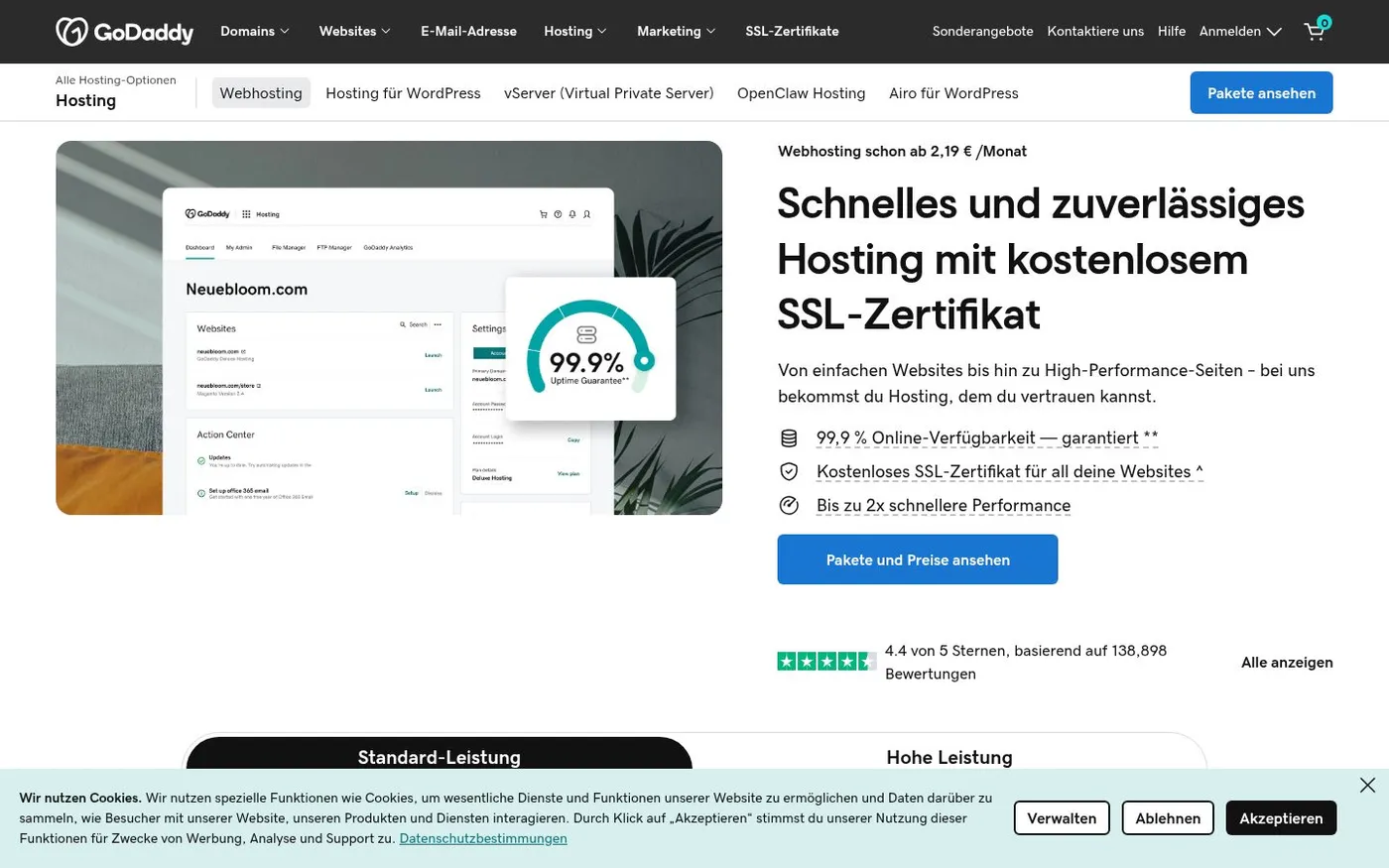
Most people don't leave GoDaddy because the platform breaks. They leave because the numbers in year two look nothing like the numbers in year one. Let's walk through exactly where the cost sits.
The real cost of a GoDaddy plan
GoDaddy's shared hosting runs on a three-year term. The headline $5.99 is what you pay when you commit for 36 months. Here's the full range, with GoDaddy's own struck-through renewal prices confirmed against the cart. You can check these on godaddy.com.
Plan | Intro (3-year term) | Renews at | Storage | Websites |
|---|---|---|---|---|
Economy | $5.99/mo | $11.99/mo | 25 GB NVMe | 1 |
Hosting for WordPress Basic | $5.99/mo | $14.99/mo | 10 GB NVMe | 1 |
Deluxe | $7.99/mo | $16.99/mo | 50 GB NVMe | 10 |
Ultimate | $12.99/mo | $21.99/mo | 75 GB NVMe | 25 |
Prices exclude taxes and fees. GoDaddy states that renewal pricing is subject to change, so the figures above are current rather than locked.
One detail worth checking on the entry plan: Economy's free SSL covers the first year, then renews at $119.99/year per GoDaddy's own disclaimer. A free Let's Encrypt certificate is an option on most hosts including GoDaddy, and the higher tiers include SSL at no renewal cost.
What "free" means at checkout
A few features listed as free on the pricing page carry conditions that only appear in the cart.
- Free email is a Microsoft 365 Email Essentials free trial for 12 months. Economy gets 2 mailboxes, Deluxe 3, and Ultimate 5. The pricing page lists it as "Free email" with no qualifier. The trial length shows up in the cart.
- Site security is a trial offer on Economy, Deluxe, and Ultimate. It's included on Hosting for WordPress Basic.
- Free domain covers the first year only, requires an annual plan or longer, and adds a $0.20 ICANN fee per year. After year one, it renews at the then-current price. A .com currently renews at $22.99/yr.
The free domain covers 27 extensions, including .com, .net, .org, .co, .info, .biz, .us, .club, .company, .design, .email, .fit, .life, .live, .online, .pro, .rocks, .shop, .site, .solutions, .space, .store, .tech, .today, .vip, .work, .world, and .xyz.
At checkout, GoDaddy also presents Web Security Standard at $7.99/mo and a Managed SSL upgrade at $72.00. If a free starting point is what you're really after, we compare seven of them, including GoDaddy's Airo credits, in our guide to the top 7 companies offering a free website.
Longer terms stop paying off
The term ladder below only appears once a plan is in the cart. It's worth reading carefully.
Plan | 1 month | 12 months | 24 months | 36 months |
|---|---|---|---|---|
Economy | $14.99 | $6.99 | $6.49 | $5.99 |
WordPress Basic | $19.99 | $6.99 | $6.49 | $5.99 |
Deluxe | $19.99 | $9.99 | $8.99 | $7.99 |
Ultimate | $26.99 | $14.99 | $13.99 | $12.99 |
Here's the finding. Hosting for WordPress Basic also offers 48 and 60-month terms, both at $5.99/mo, the same rate as 36 months. A 36-month term costs $179.64 upfront. A 60-month term costs $299.40, for the same monthly rate. Committing an extra two years buys nothing but a larger payment today.
What the refund terms say
GoDaddy publishes a 30-day money-back guarantee on annual plans. Two conditions from GoDaddy's own disclaimer are worth knowing. Monthly plans have a 48-hour refund window. And "if a hosting service has already been performed, then it is non-refundable." Both are stated here so you can plan around them.
What to look for in a GoDaddy alternative
Before you move, it helps to know what actually matters. Our guide to what best value web hosting really means goes deeper, but here's the short version.
Performance that holds up under pressure
Speed and uptime matter more than a headline price. A slow site loses visitors and rankings, no matter how little you paid for it. Look for NVMe storage, a modern server stack like LiteSpeed, and a real uptime commitment. If you want to test a host properly, we wrote up how to actually test a web host before you commit.
Honest pricing with no nasty surprises
Transparent renewal rates and bundled features beat a low intro rate every time. You want to know your year-two cost before you sign, not after. Watch for the extras that come as trials rather than as standard, since that's where the real cost hides.
Support from people who actually know hosting
Real human support looks like a person who understands your setup. Automated deflection looks like a chatbot that loops you back to an article you already read. When your site is down, the difference is everything.
The best GoDaddy alternatives in 2026

Five hosts, one clear all-round pick for value.
Flashcloud, best for value and real performance
We built Flashcloud to fix the things that push people away from hosts like GoDaddy. That means treating the extras as standard, not as trials that convert into bills.
- A free starter website built by our team.
- A free domain for life, including renewal, with privacy included.
- Free migration handled by our team, plus up to 6 free months matching unused time at your old host.
- NVMe storage and LiteSpeed for real speed.
- Your renewal rate shown upfront and fixed after the first renewal.
- An anytime money-back guarantee during the initial term.
- Daily backups, free SSL that stays free, and real human support with no AI chatbot in front.
To be straight with you: we're newer and smaller than the long-established incumbents, and we're still building our public track record. That's the honest limitation. We'd rather tell you than hope you don't notice. If you want to know where we came from, here's why we started Flashcloud.
Flashcloud is a strong fit whether you're running WordPress, WooCommerce, or need VPS hosting as you grow. See the full breakdown on our pricing page.
Namecheap, best for domain-first buyers on a budget
Namecheap is a registrar that also hosts, and its pricing is refreshingly clear.
- Stellar: $2.28/mo, renews $5.88, 20 GB SSD, backups not included.
- Stellar Plus: $2.98/mo, renews $7.88, unmetered SSD, backups included.
- Stellar Business: $4.98/mo, renews $11.88, 50 GB SSD, backups included.
Beats GoDaddy on: transparent pricing without checkout upsells, free domain privacy for life on eligible extensions, and Imunify360 malware protection included.
Falls short on: no backups on the entry plan and SSD rather than NVMe.
Best for: people who want straightforward pricing from a registrar that also hosts.
DreamHost, best for independent-minded owners
DreamHost is privately owned and flexible on billing.
- Launch: $2.89/mo, renews $10.99, 25 GB NVMe, 25 sites.
- Growth: $3.99/mo, renews $12.99, 50 GB NVMe, 50 sites.
- Scale: $9.99/mo, renews $25.99, 100 GB NVMe, 100 sites.
Beats GoDaddy on: independent ownership rather than a publicly traded group, monthly billing, daily backups on all plans, and a free starter website built by their team.
Falls short on: a non-standard custom control panel and no free domain beyond year one.
Best for: people who value independence and flexible billing.
Hostinger, best for a low beginner-friendly entry price
Hostinger leans on a low entry price and a modern dashboard.
- Premium: $2.99/mo, renews $10.99, 20 GB SSD, 3 sites.
- Unlimited: $3.79/mo, renews $16.99, 50 GB NVMe.
- Cloud Startup: $7.99/mo, renews $25.99, 100 GB NVMe.
Beats GoDaddy on: a low beginner-friendly entry price and a clean modern dashboard.
Falls short on: needing a 48-month prepay for the headline rate, an AI assistant that answers first before you reach a human, and weekly rather than daily backups on the entry plan.
Best for: beginners who want a simple dashboard and don't mind prepaying for the best rate.
AccuWeb Hosting, best for a predictable year-two bill
AccuWeb Hosting stands out for one thing: an entry plan that renews at the price you paid.
- Bootstrap++: $2.79/mo, renews at $2.79, 25 GB SSD.
- Premium++: $3.99/mo, renews $9.99, 75 GB SSD.
- Enterprise Pro++: $5.99/mo, renews $13.99, 100 GB SSD.
Renewal figures apply to the triannual term. The stack runs LiteSpeed with LSCache.
Beats GoDaddy on: an entry plan that renews at the same price you paid, which is rare anywhere in hosting, and a debt-free, privately owned company with no parent group.
Falls short on: SSD rather than NVMe, the flat renewal applies to the entry plan only since the tiers above it roughly double, and a smaller brand with less public track record.
Best for: people who want to know exactly what they'll pay in year two.
How Flashcloud compares to GoDaddy
What GoDaddy genuinely has
Let's give GoDaddy its due, because plenty is deserved.
- Migration is genuinely free. GoDaddy provides a Site Auto Migration Tool during onboarding, and their 24/7 support team will help you find the best method.
- cPanel on the three shared tiers, which most people already know.
- 24/7 phone support on every plan.
- Automatic daily backups on every plan, recovering your entire hosting account from the previous day.
- NVMe storage on every tier, with unmetered bandwidth.
- A 99.9% uptime guarantee, backed by section 9 of their hosting agreement.
- Enormous scale and a long track record. GoDaddy is publicly traded on the NYSE under GDDY.
That's a solid foundation. The trade-offs are the ones we verified above: trials presented as free features, and renewal rates that rise and can change.
The three-year picture, side by side
Here's the side-by-side, using GoDaddy's own figures.
GoDaddy | Flashcloud | |
|---|---|---|
Year 1 | $5.99/mo on a 36-month commitment | $2.79/mo on a 1-year term |
Year 2 onward | Renews at $11.99/mo, and GoDaddy states renewal pricing is subject to change | Standard rate, shown upfront, fixed from then on |
SSL | Free year one on Economy, then renews at $119.99/yr | Included, no renewal charge |
Microsoft 365 trial, 2 mailboxes free for 12 months | Included | |
Domain | Free year one, then $22.99/yr for a .com | Free for life with privacy included |
Starter site | Not offered | Built for you by our team |
Migration | Free, self-serve tool with support help | Free, handled for you, plus up to 6 free months matching unused time |
Backups | Daily, previous day recovery | Daily, 30-day history |
One note for fairness. Our rate rises once from intro to standard, then stays fixed. No year-on-year increases after that. We show you that standard rate before you buy.
Migration without the headache
Both hosts offer free migration. The difference is who does the work. GoDaddy gives you a self-serve tool with support on hand. We move your site for you, then match up to 6 free months against the unused time at your old host. If you want the full picture of what a move involves, our complete website migration checklist covers every step.
How to choose the right host
Answer three questions and the choice gets simple.
- What will this cost me in year two? If you want a fixed rate you can see upfront, choose Flashcloud. If you want a flat entry-plan renewal, look at AccuWeb.
- How much help do I want with the move? If you'd rather have it handled for you, choose Flashcloud. If you're happy self-serving, GoDaddy or DreamHost work fine.
- What matters most, price or performance? If you want the lowest entry price on its own, Namecheap wins. If you want NVMe speed with the extras included, choose Flashcloud.
How to switch from GoDaddy without the headache
Moving hosts sounds scary. It isn't, if you do it in order. For the full picture, our complete guide to switching web hosting walks through the whole process. If you want to see exactly what happens behind the scenes when you switch web hosting, we cover that too. When you're ready, our free migration team can handle the whole move for you.
Moving your domain away from GoDaddy
To transfer a domain cleanly, follow this order:
- Unlock the domain in your GoDaddy account.
- Request the authorization (EPP) code.
- Start the transfer at your new registrar and enter the code.
- Approve the transfer email.
- Keep the site live at both ends until DNS fully propagates, so you avoid downtime.
What to check before you cancel
Don't cancel anything until these are sorted.
- Renewals. Note when hosting, domain, and SSL renew, so you time the move well.
- Email accounts. Export or migrate any mailboxes before they're gone. Remember GoDaddy's email is a Microsoft 365 trial on the shared plans.
- SSL certificates. GoDaddy states you lose the associated SSL if you cancel the hosting plan. Make sure your new host has SSL ready first.
- Backups. Take a full backup of your site and database before you touch anything.
The verdict
GoDaddy is a capable, well-resourced host with genuine strengths: 24/7 phone support, daily backups, NVMe storage, and a long track record. The trade-offs sit in the fine print, where several features arrive as trials, and renewal rates rise and can change.
The alternatives here each do something GoDaddy doesn't. Flashcloud leads on value, with a free domain for life, a free starter website, free migration handled for you, and a renewal rate you can see before you buy. You deserve hosting that works as hard as you do. These alternatives give you exactly that. When you're ready, talk to our team and we'll take it from here.

Neycho Tepavicharov is the co-founder of Flashcloud, with nearly two decades in web hosting behind him and a hosting company he co-founded and sold along the way. He started Flashcloud to make hosting clearer, more generous, and genuinely supportive, and he writes about hosting, performance, how AI is changing the industry, and the occasional strong opinion about where it gets things wrong.
Connect on LinkedIn