How to check what AI assistants say about your business

Open ChatGPT, Perplexity, Claude and Google, ask the questions a customer would ask, and write down whether you appear, whether the facts are right, and which sources get cited. The sources are the part that matters.
Most business owners have never asked ChatGPT what it says about them.
That's understandable. Until fairly recently there was no reason to. But a growing share of the people looking for a supplier, a service or a professional now ask an assistant instead of scrolling through search results, and what comes back is a short answer naming two or three options with a line about each.
If your business appears in those answers, it matters what they say. If it doesn't appear at all, that matters more.
The good news is that checking takes about twenty minutes and costs nothing. Here's how to do it properly.
Ask the questions your customers would ask

Think like a customer: ask AI assistants the same questions your prospects would.
Open ChatGPT, Perplexity, Claude and Google. Use each one, because they draw on different sources and give noticeably different answers.
Google needs a word of its own, because it has two AI surfaces and they are not the same thing. AI Overviews appear above ordinary search results, and Google's documentation says they are "only shown when our systems determine that it is additive to classic Search, and as such, often don't trigger." AI Mode is a separate mode you enter deliberately. Google states plainly that the two "may use different models and techniques, so the set of responses and links they show will vary." Check both, and don't conclude anything from an AI Overview that simply didn't appear.
Then ask three kinds of question.
Category questions, the way a stranger would phrase them. "Best accountant for small businesses in Austin." "Who does commercial property law in Manchester." "Dentist in Leeds taking new patients." "Recommend a web host for a small online store." Don't use your own marketing language, use the words a customer would use.
Direct questions about you. "Is [your business] any good." "What does [your business] do." "Tell me about [your business]." This is where you find out whether the facts are right.
Comparison questions. "[Your business] vs [a competitor]." "Alternatives to [your business]." "Who are the main competitors to [your business]."
Do this from a signed-out or private window where you can. A logged-in session may be shaped by your own history, which is exactly what you don't want when you're trying to see what a stranger sees.
Write down what you find
Keep it simple. For each question, note four things.
Did you appear at all, and where in the answer. Being named third is a very different position from not being named.
Was what it said accurate. Check the specifics: what you do, where you operate, who you serve, what you charge, who works there.
What did it get wrong or leave out. Missing information is as important as incorrect information, and it's more common.
Perplexity and Google's AI usually display these. This is the most useful part of the whole exercise, and we'll come back to it.
The three things you're actually looking for
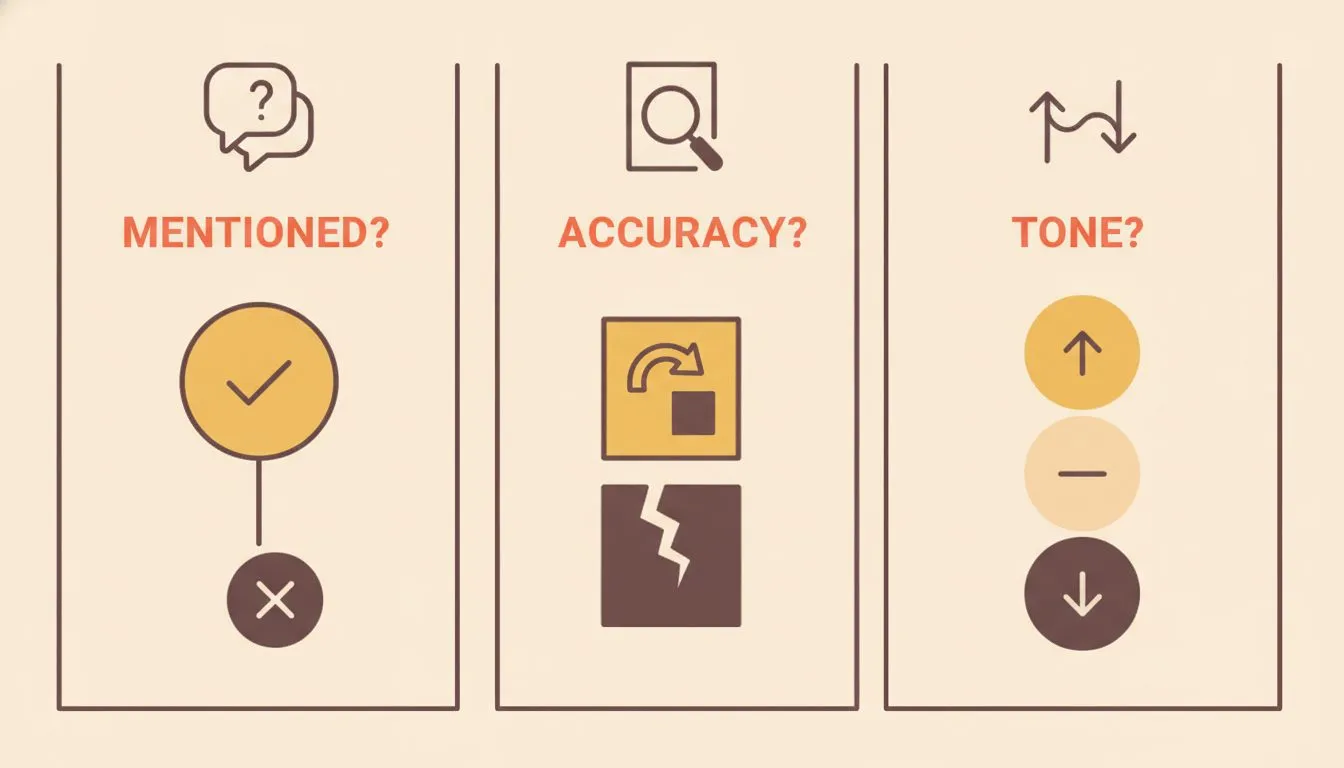
The three things that matter when an AI talks about your business.
Absence. You aren't mentioned when you should be. This is the most common result for smaller businesses and the hardest to fix quickly, but it's worth knowing.
Inaccuracy. You're mentioned but something is wrong. Old pricing, a service you no longer offer, a location you've moved from, a partner who left. This is usually fixable, because the source is normally your own website.
Miscategorization. You're described as something you aren't. This happens when an assistant has thin information and fills the gap by inference. It's worth catching early, because a wrong description tends to persist.
Where the answers come from
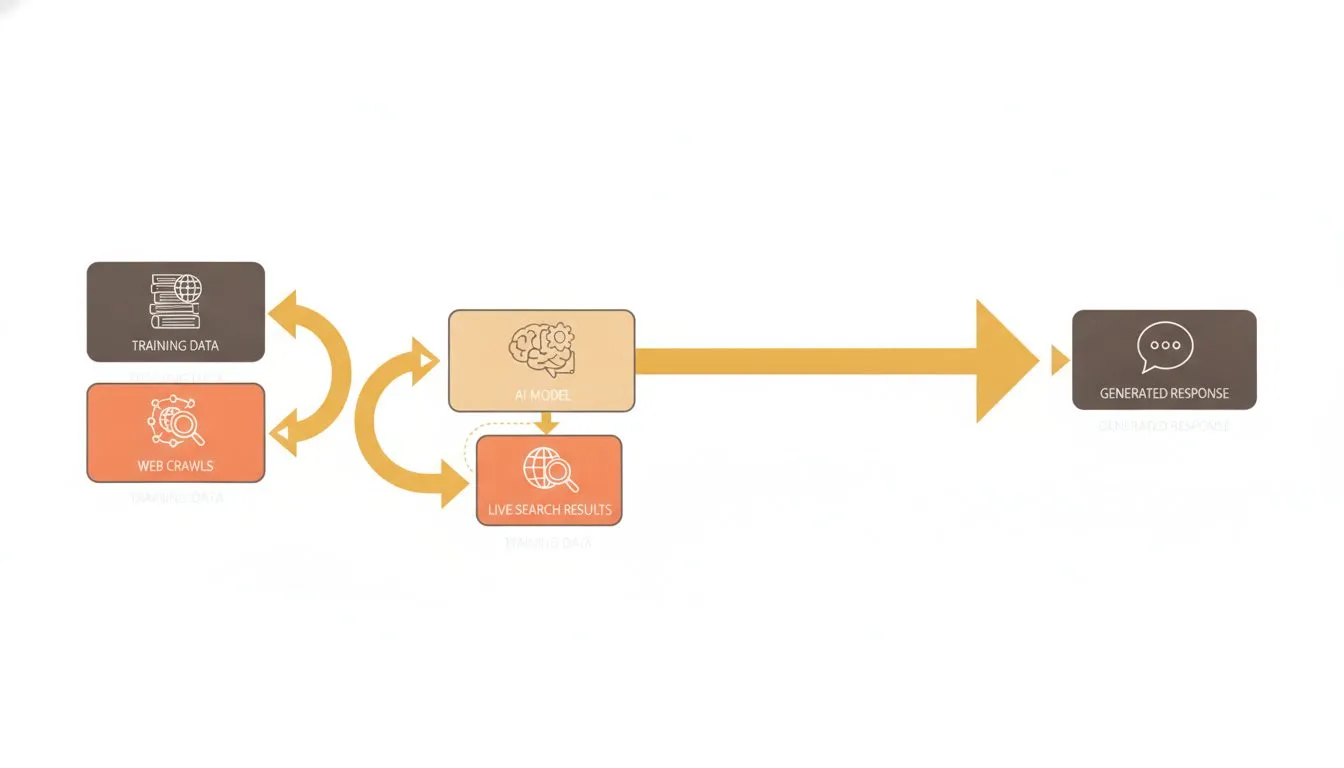
Where AI answers actually come from: training data, retrieval, or both.
This is the part that turns the exercise from interesting into useful.
Look at the sources cited in those answers. Bear in mind that assistants can only use what they can reach, so it's worth knowing which crawlers you're allowing and blocking. For most categories you'll see the same handful of sites appearing again and again: directories, review platforms, comparison articles, industry roundups, and often the businesses' own websites.
Those sources are where the answer is actually being built. If you're absent from them, you're absent from the answer, and no amount of work on your own site changes that on its own.
One pattern is worth knowing before you start. The assistants do not draw on the same kinds of source as each other. Ask the same question of ChatGPT and Perplexity and you will often get two different sets of citations: ChatGPT tends to cite a small number of sources, frequently the companies' own websites, while Perplexity tends to cite many more and leans heavily on third-party comparison sites and directories.
That difference is useful. If you are absent from ChatGPT's answers, the work is usually on your own site. If you are absent from Perplexity's, the work is usually somewhere else entirely.
Two things follow.
First, your own website matters more than it used to, because it's usually the most heavily weighted source about you specifically. There are technical steps worth considering to help assistants read it properly, though it is worth knowing that Google states none of them are required for its own AI features: "You don't need to create new machine readable files, AI text files, or markup to appear in these features. There's also no special schema.org structured data that you need to add." The content itself matters considerably more than the plumbing. The details that get repeated - services, locations, pricing, credentials, staff - are frequently the least maintained pages on any business site, written once at launch and rarely revisited. If they're wrong, an assistant will repeat them confidently to everyone who asks.
Second, being present and accurate in the third-party sources those answers cite is worth real effort. This is the bigger shift underneath all of it: visibility is moving from ranking well to being cited widely. That means claiming and completing your listings on the directories and review platforms that come up, and being included in the roundups and comparison articles that get cited. Earned mentions in credible places do more here than anything you can buy.
Check whether the assistants can reach you at all
There is a second check worth running, and almost nobody does it.
Assistants send crawlers to read websites, and those crawlers identify themselves. If you have access to your server logs, or your hosting control panel shows raw access logs, search them for the names these companies publish: GPTBot, OAI-SearchBot and ChatGPT-User from OpenAI, ClaudeBot and Claude-SearchBot from Anthropic, PerplexityBot from Perplexity, Google-Extended from Google, Applebot-Extended from Apple.
If none of them appear, something is stopping them. The usual culprits are a robots.txt rule blocking them, a firewall or bot-protection service treating them as unwanted traffic, or a site that renders entirely in JavaScript with nothing in the initial response for a crawler to read.
That last one catches people out. A site can look perfect to a visitor and be almost empty to anything that does not run JavaScript.
What the companies themselves publish about this
It is worth knowing how little is documented, because it sets a realistic expectation for what you can influence.
OpenAI publishes the clearest statement of the three, and it is a warning rather than a promise. Its help documentation says ChatGPT "ranks search results using multiple factors intended to help users find relevant, reliable information. Placement is not guaranteed." The factors themselves are never listed. On eligibility, OpenAI says any public website can appear, provided you allow its crawler and your host or CDN is not blocking its published IP addresses.
Two details from the same documentation are worth knowing. ChatGPT "sometimes partners with other search providers" and rewrites your question into targeted queries for them, so the answer is not always built from OpenAI's own index. And blocking the crawler does not fully remove you: OpenAI states that if it obtains a disallowed page's URL from a third-party provider, it may still surface the link and page title.
Anthropic publishes the mechanics but not the ranking. Claude's documentation describes when it searches rather than what it picks, and it confirms that Claude's web search is served by third-party search partners, which it does not name. Site owners are given controls to remove content, but not an explanation of selection.
Perplexity, despite building its reputation on citations, publishes the least. Its own help article describes gathering information from "top-tier sources" and "authoritative sources" without defining either term, and gives no ranking statement, no eligibility criteria, and no account of whether it uses its own index or someone else's.
The common thread is that none of the three publishes its ranking factors, none defines what makes a source authoritative, and none offers any way to ask why a particular source was or was not used. If you were hoping for a lever to pull, there isn't one. That is precisely why the work is editorial rather than technical.
What to do with what you find
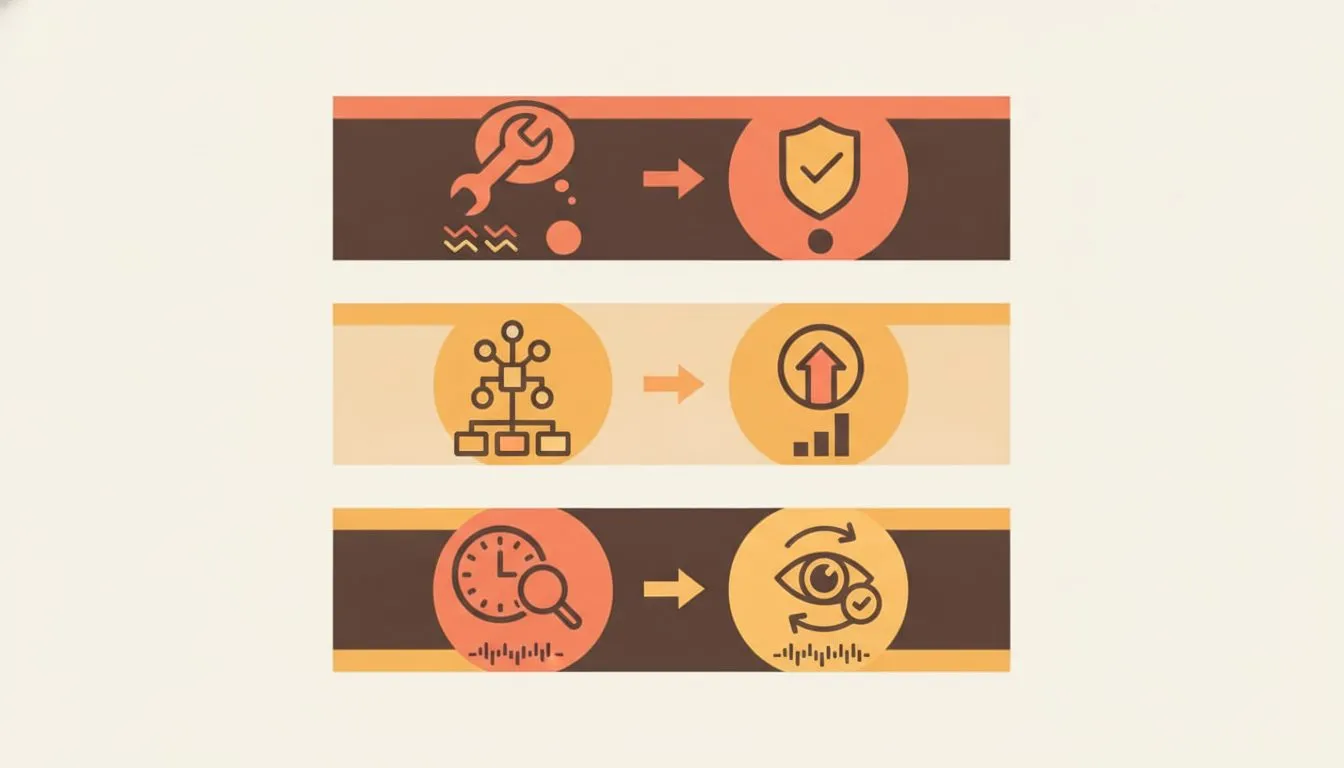
A simple action plan for improving how AI assistants describe your business.
Fix your own site first, because it's free and it's under your control. Go through the specifics an assistant would repeat and make sure each one is currently true. Pay particular attention to anything that would cause a customer a problem if it were wrong. We published what an independent reviewer found when they tested us, criticisms included, for the same reason: it's better for the accurate version to come from you.
Then look at the sources. Claim the listings you're missing. Complete the profiles you've half-filled. Correct anything inaccurate on platforms you can edit.
One measurement note while you're at it. ChatGPT appends a tag to the links it sends, so referrals from it show up in ordinary analytics as coming from chatgpt.com. If you have never looked, it is worth checking whether any of that traffic is already arriving.
Then set a reminder to do the whole check again in three months. Answers change as models update and as sources change, and a result that was accurate in January may not be in April.
What not to do
Don't try to game it. Stuffing your site with phrases you'd like an assistant to repeat produces the same result it produced in search fifteen years ago, which is content that reads badly to humans and isn't especially convincing to machines either.
Don't panic if you're absent. Being cited by AI assistants is a slow-accumulating thing built on credible presence across multiple sources. It takes months, not days, and buying your way there generally doesn't work.
And don't treat one bad answer as definitive. Ask the same question a few times and in a few different ways. Answers vary more than people expect, and one poor result may not be representative.
It is also worth knowing that some questions simply do not produce recommendations. Ask an assistant how to solve a problem rather than who to hire, and you will often get a set of steps with no company named anywhere. That is not a failure on your part. It means the question itself does not call for a supplier, and you should judge your visibility on the questions that do.
The honest summary
This is not a technical problem and there is no tool that solves it. It's an accuracy and presence problem, and the work is mostly editorial: make sure what you say about yourself is true and current, make sure you exist in the places people and machines look, and check periodically that the picture being painted resembles the business.
Twenty minutes now will tell you where you stand. Most of your competitors haven't looked.

Neycho Tepavicharov is the co-founder of Flashcloud, with nearly two decades in web hosting behind him and a hosting company he co-founded and sold along the way. He started Flashcloud to make hosting clearer, more generous, and genuinely supportive, and he writes about hosting, performance, how AI is changing the industry, and the occasional strong opinion about where it gets things wrong.
Connect on LinkedIn