How to hire someone to build a website

To hire someone to build a website well, write a brief that spells out pages, copy and deadline, get two or three quotes so you can see where the middle sits, and agree in writing who owns the domain, the hosting and the finished files before any work starts. That last point matters more than the price.
You've decided to hire someone to build a website rather than build it yourself. Good call, if your time is worth more than the hours it would take. This guide is for you: the business owner or creator who wants a professional to do the work and wants to do the hiring part right. It's not a comparison of routes. If you're still weighing that up, start with our guide to how to get a website, then come back here.
We checked 27 web design firms in September 2026 and read what they publish about price, timelines, ownership and maintenance. Every figure below is taken from a firm's own website. Where a firm publishes nothing, we say so, because the silence is part of the picture.
What this market actually publishes
Start here, because it frames everything else. Web design is one of the few markets where you often can't see the price before you ask.
Of the 27 firms we checked, thirteen publish a build price on their own site. Fourteen do not. Several of the fourteen rank for pricing searches on a page that explains what the industry charges without ever stating what they charge.
Among the thirteen that do publish, the spread is too wide to average:
- WebFX starts at $8,000 per site
- AdverGroup runs tiered packages from $1,500 to $6,995, across 5 to 40 pages
- Designstaq charges $2,950 to $11,250 for Squarespace builds
- One designer sells a $3,000 single-day service
- Hook Agency splits $12,000 across twelve monthly payments
Turnaround varies just as widely. TL Web Design Studio quotes one to two weeks. Straight North quotes five to twelve weeks depending on tier. WebFX quotes three months to twelve.
Here's the practical point. With no standard price and no standard timeline, a single quote tells you almost nothing. It's a number floating in space. Two or three quotes, all answering the same brief, tell you where the middle is for your specific project. That's the number you can actually make a decision with.
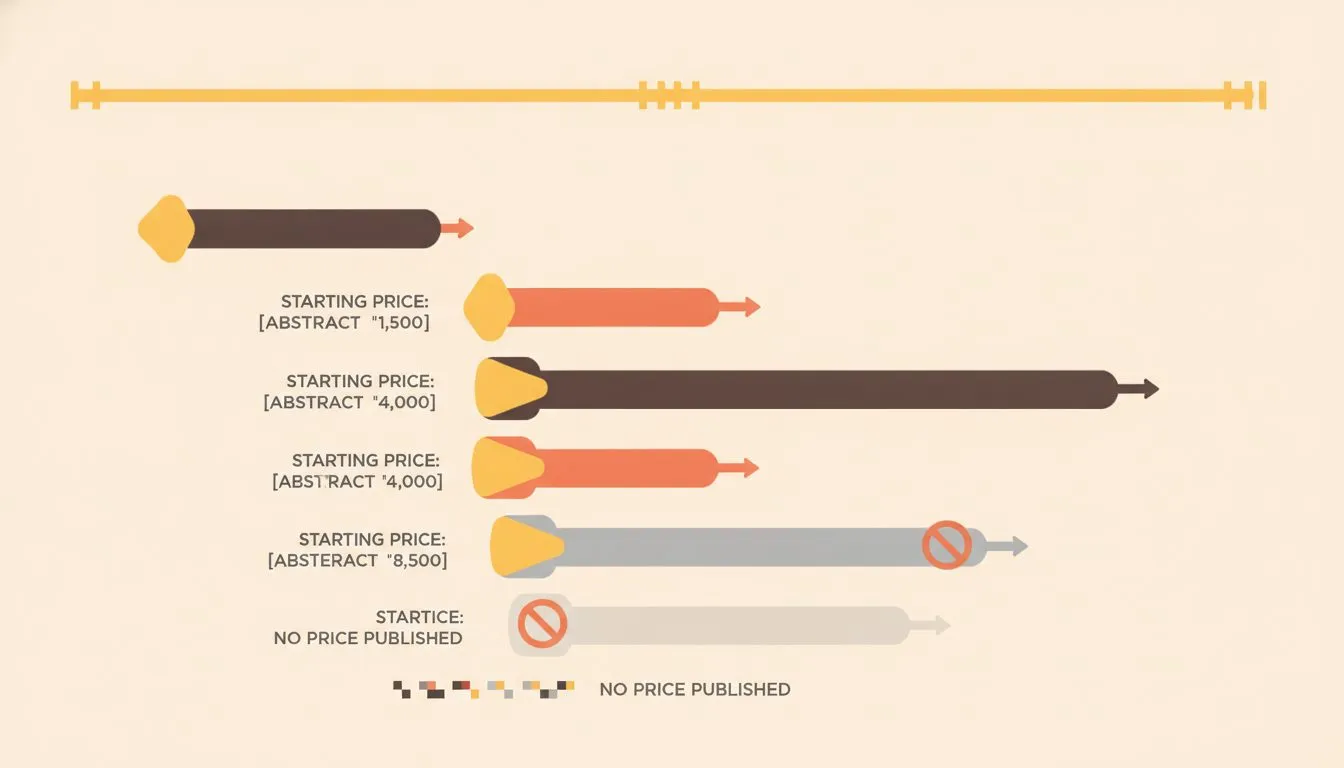
Published build prices vary so widely that one quote on its own means little.
Writing a brief worth quoting against
This is the section that changes your outcome, and almost nobody writes it. A vague brief produces quotes you can't compare, because each firm has quietly scoped a different project. One assumes you're writing the copy. Another assumes they are. You end up comparing apples to invoices.
A brief worth quoting against covers all of this:
- How many pages, and what each one is for. "A few pages" is not a number. List them.
- Who writes the copy, you or them. This is the single biggest variable in a quote. Say it clearly.
- Who supplies photography, and whether stock is acceptable.
- Whether the site needs to take payments, bookings or form submissions. Each one changes the build.
- Whether you have brand assets already, or need a logo.
- Which platform, if you have a preference, and why.
- What "done" looks like, in a single sentence.
- Your actual deadline, and what it's tied to. A launch event beats "as soon as possible" every time.
Then the part people skip: say what you don't need. A brief that rules nothing out invites a quote that includes everything. If you don't need a blog, a booking system or a members' area, write that down. It keeps the quotes lean and comparable.
How to read a quote
Once the quotes come back, three things decide whether you're comparing like with like. Each has a concrete test.
What's in the number, and what's beside it
AdverGroup's tiers are defined by page count, from 5 pages to 40. Designstaq's range covers a single platform. The number only means something once you know what it buys. A quote with no page count isn't a quote. It's an opening position. Send it back and ask for the scope.
Whether content is included
A build price that assumes you supply finished copy for every page is a completely different product from one that includes writing it. Writing sells. Writing takes hours. If the quote doesn't state who's writing, ask directly, because it's rarely spelled out and it's usually the biggest hidden difference between two numbers.
What happens when you change your mind
You will change your mind. Ask how revisions are counted and what triggers an extra charge. The paid-build market is more explicit about this than the free-build market. Where revision terms are published at all, they tend to be counted in rounds per page. Get that in writing before you sign, not after your third round of edits.
What to agree before work starts
This is the most important section in the article, and it's backed by our strongest finding.
Of the ten firms we checked that publish pricing, six publish nothing at all about who owns the finished site. Two state it in a terms document. Two more mention it only in sales copy, which is not the same thing as a contract term.
Where ownership is published, it's reassuring. TMN Creative's terms read:
"Upon full payment for completed website projects, clients receive ownership of the website files and project assets created specifically for their project."
The point isn't that designers are trying to keep your site. Most aren't. The point is that most say nothing either way, so the answer becomes whatever you agree at the start. If you agree nothing, you own nothing on paper.
Settle four things in writing before work begins:
- Who registers the domain, and in whose name and account.
- Who holds the hosting account, you or them.
- What you receive at handover: files, database, all logins, and in what form.
- Whether the contract assigns copyright in the design and code to you.
The first two decide everything else. If the domain is registered in your name and the hosting account is yours, you can recover your site without anyone's cooperation, whatever happens to the relationship. If both sit inside the builder's account, you can't. You're asking permission to access something you paid for.
So register the domain yourself, or insist it's registered in your name. Our guide to choosing a domain name that works for your business covers picking one, but the ownership rule is simple: your name, your account, your control.
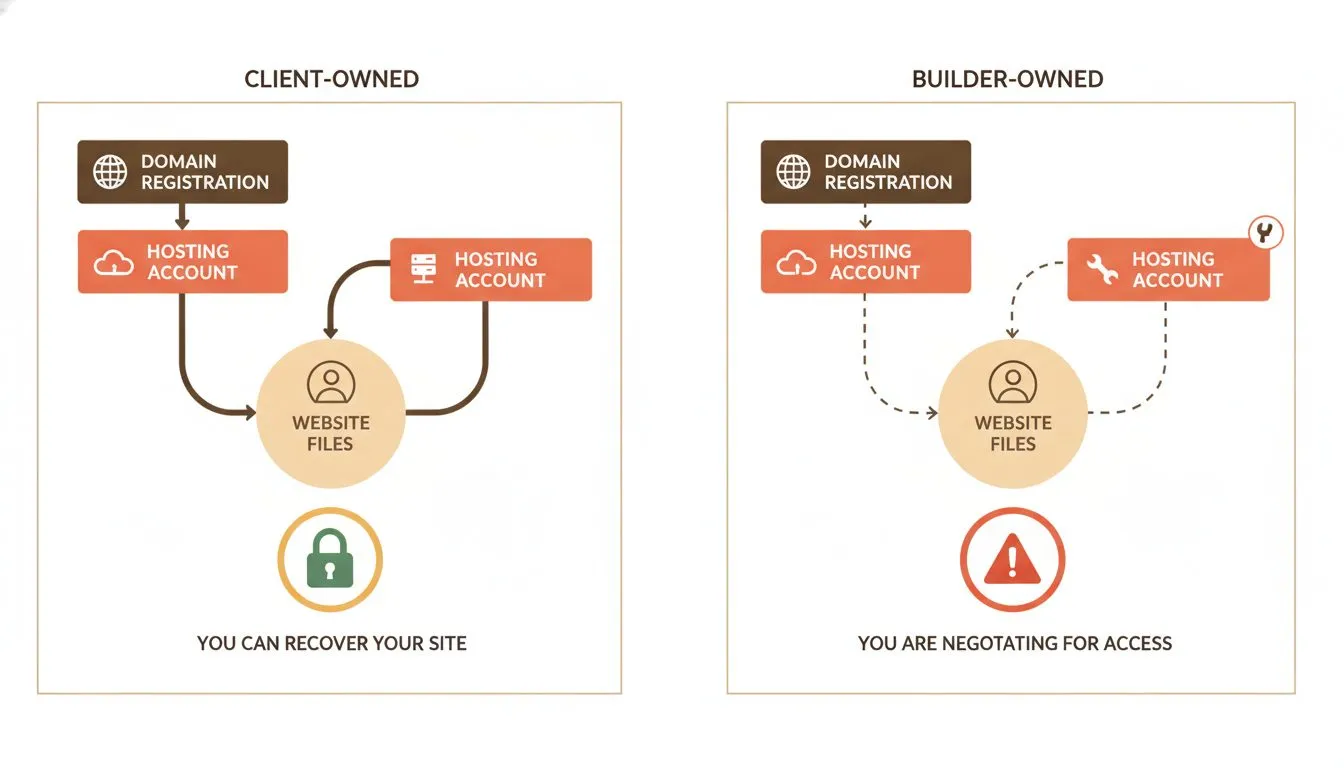
Who holds the domain and hosting account decides whether you can recover your site later.
What happens after they hand it over
The build is a one-off. Keeping the site running is not, and this is the cost nobody budgets for.
Published maintenance retainers run from $35 a month to $2,190, with most small business plans landing between $49 and $250. They typically cover core and plugin updates, backups, security monitoring, and a small allowance of content edits. Useful, if you know what's inside.
Two things to check before you compare two retainers.
Whether hosting is inside the price
Of eleven published retainers we looked at, five include hosting, one includes it only on the top tier, one explicitly excludes it, and four don't mention it at all. So a $39 plan and a $99 plan may not be comparable, and neither page will tell you which one includes your hosting. Ask.
What counts as an edit
The word "task" hides a lot. SiteCare defines a task as "under thirty minutes". GoWP says "about 30 minutes or less". Fixed.net advertises unlimited tasks and then excludes "redesigns, page builds, new functionality". Unlimited usually means unlimited small things. Read the definition, not the headline.
One thing worth knowing: if a retainer is mostly paying for hosting plus routine updates, hosting that already includes daily backups, staging and real human support covers a good part of what you'd otherwise pay for. That's what you get with Flashcloud hosting, and it's worth weighing against a retainer that bundles the same things at a markup.
When it goes wrong
This is the part people search for at 11pm. Two failures come up most often.
The work stalls, or the quality isn't what was agreed. Your leverage here depends entirely on what you agreed in the section above. A clear scope, a payment schedule tied to milestones and a written revision policy give you something to point to. A handshake gives you nothing.
The person stops answering. Now the domain and hosting questions decide everything. If the domain is registered in your name, you can point it elsewhere and rebuild, frustrating as that is. If it isn't, you're negotiating for something you thought you already owned.
If you're in this position, work through it in order:
- Check the domain's registrant record. Are you named as the registrant?
- Check who the hosting account is billed to. Is the card yours?
- Request a full export in writing: files, database and logins.
- Keep the paper trail. Every request, every reply, dated.
If the domain and hosting are yours, moving the site to a new host is a known process, not a crisis. Our guide to switching web hosting walks through it. If they aren't yours, sorting the ownership out is the first job, before anything else.
We have no data on how often this happens, so we won't guess. Most projects finish fine. The steps above are simply what turns a bad situation from unrecoverable into an inconvenience.
The short version
Hiring someone is a smart route when your time is worth more than the build. Do it well and you'll save yourself money and stress. Write a brief that spells out scope, copy and deadline. Get two or three quotes so you can see where the middle sits. Agree ownership of the domain, hosting and files in writing before work starts. Then keep the domain and hosting in your own name, so the site is always yours to recover, move or grow.

Neycho Tepavicharov is the co-founder of Flashcloud, with nearly two decades in web hosting behind him and a hosting company he co-founded and sold along the way. He started Flashcloud to make hosting clearer, more generous, and genuinely supportive, and he writes about hosting, performance, how AI is changing the industry, and the occasional strong opinion about where it gets things wrong.
Connect on LinkedIn