How Much Should a Website Cost for a Plumber or Electrician?

Quotes for the same five-page website can differ by thousands of dollars. A plumber hears one number from a freelancer. An electrician hears a very different one from an agency, and a third from the field service software he already uses for invoicing.
Most of the people who'll judge that website will do it on a phone. About nine in ten US adults (91%) own a smartphone, according to Pew Research Center's 2025 survey. A homeowner with water on the kitchen floor decides in seconds whether to call you or the next result.
This guide breaks down what a website really costs a trades business in 2026. You'll see six routes with real published prices, the costs that hide behind a quote, and how to tell a fair price from an inflated one.
The short answer
A plumber or electrician can pay under $40 for a first year or more than $24,000. Both can make sense. The right price is the lowest one that still gets you a fast, professional site that you own.
Here's how the routes compare, using prices published on each company's own website.
Route | Year one | After year one | Who builds it |
|---|---|---|---|
Website builder (Squarespace, Wix) | About $144 to $468 | The subscription continues; the domain renews separately | You |
WordPress you build yourself | About $50 to $600 | Hosting moves to its renewal rate, typically $8 to $15 a month | You |
Field service software with a website (Jobber) | $348 to $588 for a solo operator | The same subscription, and the site lives only while you pay | You, with their builder |
Freelancer or small studio | From $1,500 for the build | Hosting and domain, plus any maintenance retainer | A designer |
Marketing agency | $8,000 to $24,000 for the build | Monthly marketing retainers on top | An agency team |
Hosting with a site built for you (Flashcloud) | $33.48 on the annual term | $9.99 a month, then fixed | A person on our team |
None of these include ads, SEO campaigns or professional photography. Builder and agency renewals are often unpublished, so treat anything after year one as an estimate.
Why quotes vary so much
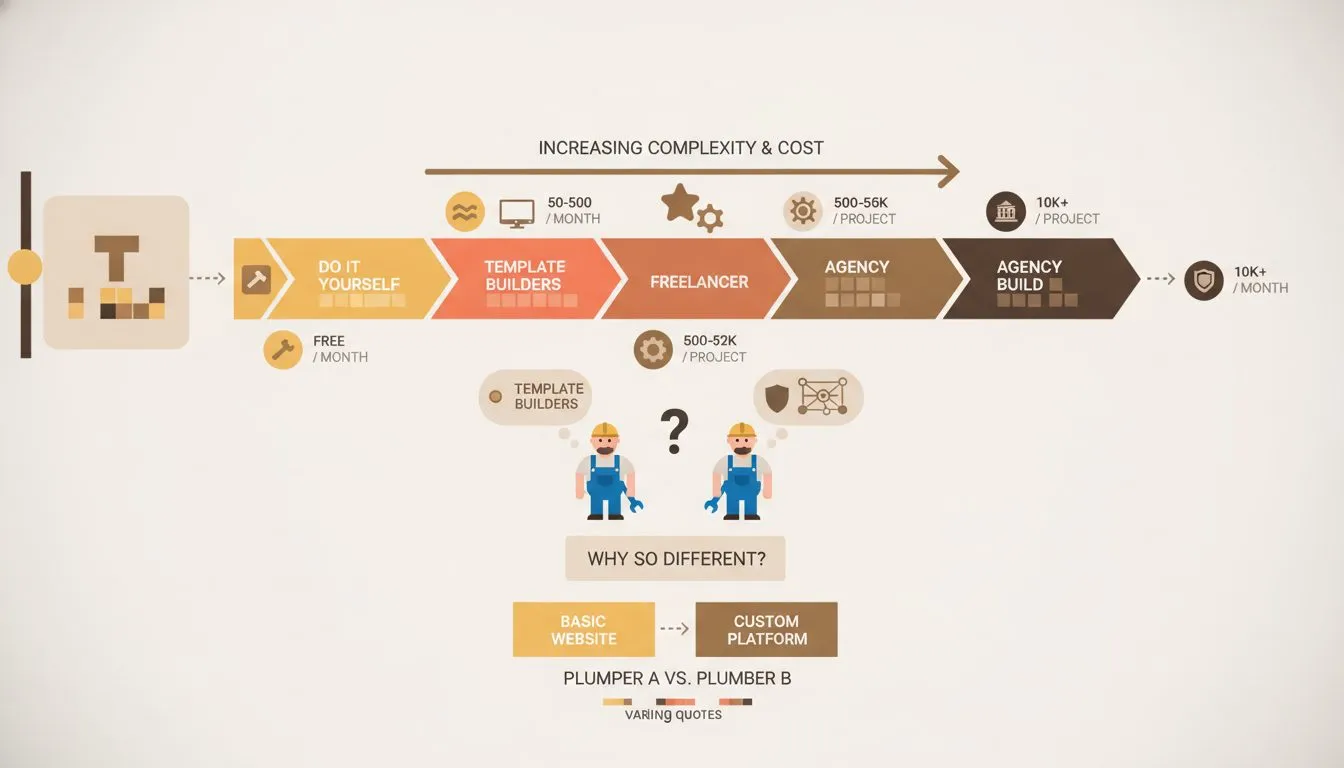
Website quotes for trade businesses can span from under $20/month to over $10,000 - here's why.
Two quotes can both be honest and still sit $5,000 apart. The gap usually comes from five things, and knowing them helps you compare like with like.
Scope comes first. A five-page site costs far less than a thirty-page build with a booking tool, a payment form and a page for every town you serve. More pages mean more design, more writing and more testing.
Content is the second driver. Someone has to write your service descriptions and gather your photos. If the vendor does it, the price rises. If you do it, your time isn't free.
Design is the third. A template with your logo and colors is quick to produce. A fully custom layout takes real designer hours. For a trades business, a clean template usually does the job.
Integrations come fourth. Scheduling, call tracking and payment forms each add setup work, and sometimes a monthly fee. Add them only when you'll use them.
The fifth is what's bundled. Some quotes include hosting, a domain, email and upkeep. Others bill each one separately, and the totals drift apart fast.
The costs that hide behind the build price
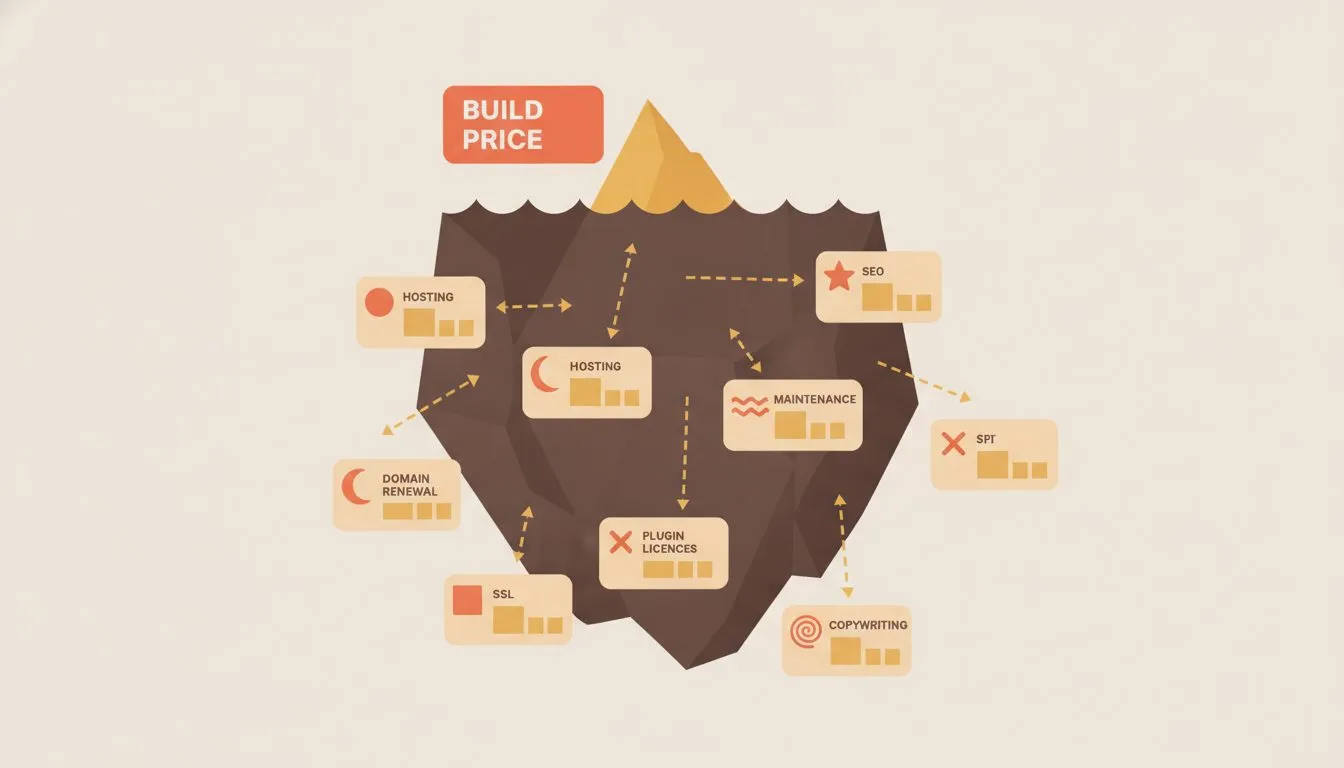
The build price is just the tip of the iceberg - these are the costs that add up over time.
A quote covers the build. It rarely covers everything a trades website needs to stay online and look credible. Ask about each of these before you sign.
- Domain name. A .com runs roughly $12 to $20 a year across the major registrars. Watch the renewal: GoDaddy advertises a .com for $0.01, but that price needs a three-year term where years two and three cost $22.99 each, and it renews at $22.99 after that.
- Business email. An address like service@yourcompany.com looks more trustworthy than a free webmail account. Many hosting plans include email on your own domain. Zoho Mail's free plan covers up to five mailboxes but works only through Zoho's own webmail and apps, and Google Workspace is a paid per-user service.
- SSL certificate. This puts the padlock in the browser and keeps form data private. Most hosting plans and builders include one free, so a quote that charges for it deserves a question.
- Photography. Clear photos of your own crew, trucks and finished jobs cost nothing and often work better than stock.
- Maintenance. Published maintenance retainers run from $35 a month to $2,190, with most small business plans between $49 and $250. Of eleven we checked, only five said hosting was included.
- Renewal pricing. Many hosts advertise a low first-year rate, then renew far higher. Check the renewal figure before you pay.
- Marketing. Ads, local SEO and review tools are separate budgets. Hook Agency, for example, publishes local SEO from $2,800 a month and pay-per-click management from $2,000. A website alone doesn't buy you traffic.
- What happens when you leave. This is the hidden cost nobody prices. Some platforms take your website offline the day you cancel. Ask before you sign, not after.
Add these up before you compare quotes. A low build price with pricey extras can cost more than a higher all-in price.
Route 1: a website builder
A website builder is a low-risk way to start. You pick a template, swap in your logo and publish. Squarespace's Basic plan is $12 a month billed annually, or $144 for the year, with the domain free for year one. Wix runs from $19 to $39 a month for its main plans, billed yearly, and publishes no renewal price.
The real cost is your time. If you bill by the hour, every evening spent on layouts is an evening not spent on a paid job. Many owners start strong, then stall on page three.
Ownership is the other catch. Builders keep your site on their platform, and moving later often means rebuilding. Our guide to website builders versus WordPress covers what you can take with you.
This route suits an electrician with a quiet winter and some patience. It's a poor fit if you're already booked solid.
Route 2: WordPress you build yourself
WordPress is free software. You pay for hosting and a domain, and optionally for premium themes and plugins. A five-page site on entry hosting with free plugins comes to about $50 in year one. Add a modest set of premium plugins and it reaches about $500.
You own the files and can move hosts whenever you like. The trade-off is that you handle the setup and the updates. If you want to try it, our step-by-step guide to building a website yourself walks through it in order.
Route 3: field service software with a website
Many plumbers and electricians already pay for software that runs scheduling, quotes and invoicing. Some of it includes a website.
Jobber includes a website builder on every plan. For a solo operator, its Core plan is $49 a month with no commitment, or $29 a month paid annually, so $348 to $588 a year. Quote requests and online booking can sit right on the site, and your own domain connects properly.
Housecall Pro sells a done-for-you website as an add-on, but doesn't publish its price. NiceJob, which starts from reviews, charges $99 a month for its website add-on plus a $199 setup fee, on top of a $75 plan.
Read the exit terms, because they matter here more than anywhere. Jobber says your website stays online only as long as you have an active subscription. NiceJob states that it removes all content from the internet when you cancel. Our comparison of website companies for plumbers and electricians quotes each platform's terms in full.
This route suits a contractor who wants one app for the whole business and plans to stay on it.
Route 4: a freelancer or small studio
A freelancer gives you a custom look without an agency price tag. In our review of published web design prices, only 13 of 27 firms published a build price at all. Among those that did, packages started at $1,500 for a small site, and one firm's tiers ran from $1,500 to $6,995 across 5 to 40 pages.
Timelines vary as widely, from one or two weeks to several months. Freelancers usually expect you to supply the words and photos, which is real work for a busy owner. Ask whether copywriting is included and how many revision rounds you get.
Ownership matters most here. Put the domain and hosting account in your own name from day one, and get the copyright transfer in writing before work starts.
Route 5: a marketing agency
Agencies sell more than a website. A typical package bundles design, local SEO, paid ads and monthly reporting.
A few publish their prices. Hook Agency, which works only with home service trades, charges $12,000 for a standard website, split across twelve months, and $24,000 for a custom one. It says its services are aimed at businesses generating $3 million to $15 million a year. WebFX starts at $8,000 per site. Scorpion and Blue Corona quote custom prices, and Scorpion typically asks for a 12-month contract for the website and SEO.
That's a fair price for the right business. A multi-truck plumbing company with a real ad budget can turn a bigger site into booked jobs. A solo electrician rarely needs that much.
Before that sales call, ask three questions: how long is the contract, who owns the site, and what does leaving cost? Answers range from Blue Corona's "Once it's built, it's 100% yours" to Scorpion's static files and a rebuild elsewhere.
Route 6: hosting with the website built for you
Full disclosure: we're the team behind Flashcloud, so we're not neutral here. We've kept the numbers sourced and the trade-offs honest.
This route skips the build bill entirely. You buy a hosting plan, and a person on our team builds your starter website at no extra charge. It's one purchase instead of a stack of them.
What the free build includes
Our free starter website is a real, fully editable site of up to five pages, built around your trade and your service area. If you need a logo, we make one, and we supply starting photos and text if you have none.
It isn't a drag-and-drop builder, and it isn't an AI generator. A person builds it, usually within one to two working days. You get one free revision, and the site stays fully editable after launch.
What you'll pay
The Start plan costs $2.79 a month on the 12-month term, renewing at $9.99. On the 3-year term it's $2.99 a month, renewing at $8.99. Both include 25 GB of NVMe storage, 2 CPU cores, 2 GB of RAM and one website.
Neither term is simply the lower-cost choice. The annual term wins year one, at $33.48 against $35.88. The 3-year term wins after that, thanks to the lower renewal.
The domain is free for as long as you stay, with privacy. SSL, daily backups with 30-day retention and email on your domain are included, as is human support. If you're leaving another host, migration is free, and we match unused time at your old host with up to six extra months on the new plan.
Where it falls short
Five pages is a starter site, not a full city-by-city service-area build. If you want thirty pages, you'll add them yourself or pay for help. An online store isn't part of the free build.
There's no scheduling, invoicing or dispatch, the way Jobber has, and no ad management or SEO campaign. We're also newer than the big names: Flashcloud launched in early 2026, run by founders with nearly 20 years in hosting.
The three-year view
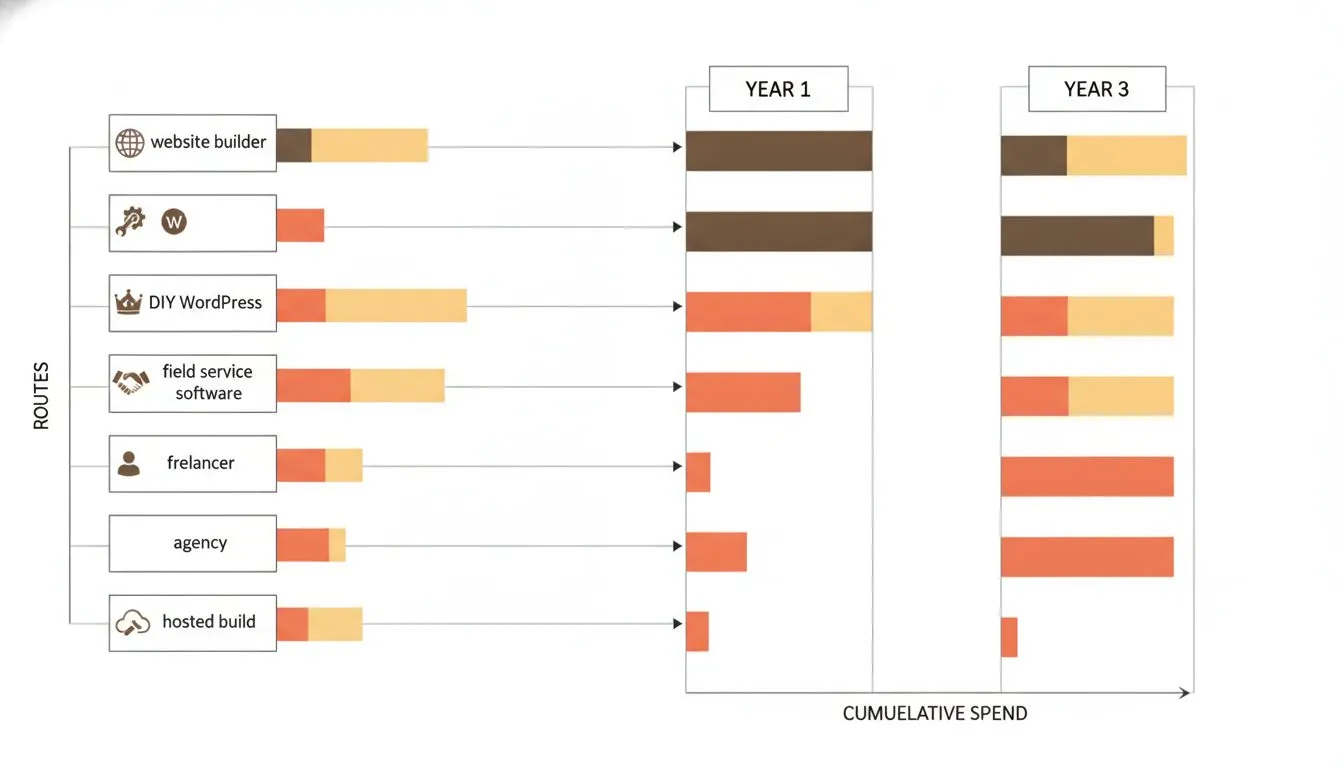
Spread the cost over three years and the cheapest option up front isn't always the cheapest overall.
Year one is a poor way to compare. A website is a three-year decision, so here's the math across all three, using published prices. These are estimates, since several vendors don't publish renewals.
Route | Three-year cost |
|---|---|
Flashcloud Start, 3-year term | $107.64, domain included |
Flashcloud Start, annual term | $33.48 + $119.88 + $119.88 = $273.24, domain included |
WordPress you build, free plugins | About $270 to $440: domain $42, hosting about $36 in year one then $8 to $15 a month |
Squarespace Basic, billed annually | $432, plus the domain renewal in years two and three |
Jobber Core, solo, paid annually | $1,044 |
Jobber Core, solo, month to month | $1,764 |
Freelancer at $1,500 | About $1,770 to $1,940 with hosting and domain, before any retainer |
Hook Agency standard website | $12,000, before hosting or marketing |
A maintenance retainer changes the picture fast. At $49 to $250 a month, three years adds $1,764 to $9,000 to any of these.
What a plumber or electrician website needs to include

Every trade website should hit these essentials before worrying about anything else.
Pages are easy to count. Calls are harder to earn. Your money should buy the features below, whichever route you choose.
Put a tap-to-call phone number at the top of every page. Homeowners with a leaking pipe won't hunt for a contact form. Nielsen Norman Group's mobile guidance says to prioritize essential information, and your number tops that list.
Show your service area in plain words. List the towns and neighborhoods you cover, and state your license and insurance details clearly, because they answer the trust question fast.
Add real photos of your crew, your truck and finished jobs. Include a handful of genuine reviews, mention emergency availability if you offer it, and keep the quote form short.
Finally, make the site load quickly. Slow pages lose impatient visitors before they see any of the above.
None of this requires a big budget. A five-page site can carry all of it: home, services, service area, about and contact.
Common mistakes that waste money
Buying SEO before the site works. Search work pays off when visitors land on a fast page with a visible phone number. Fix the page first, then pay to send people there.
Paying for pages nobody will read. Thirty thin pages rarely beat five clear ones. Add a page when you have something real to say about a specific service or town.
Letting someone else hold the keys. If a vendor registers your domain or controls your hosting login, you're renting your own web address. Our guide to choosing a domain name covers registering it properly in your own name.
Ignoring renewal pricing. A low first-year rate feels great until the second invoice arrives. Look for a vendor that shows the renewal rate before you pay.
Skipping the phone test. Open your site on your own phone, in bright sunlight, with one thumb. If you can't find the call button in three seconds, neither can a stressed homeowner.
How to read a quote before you sign
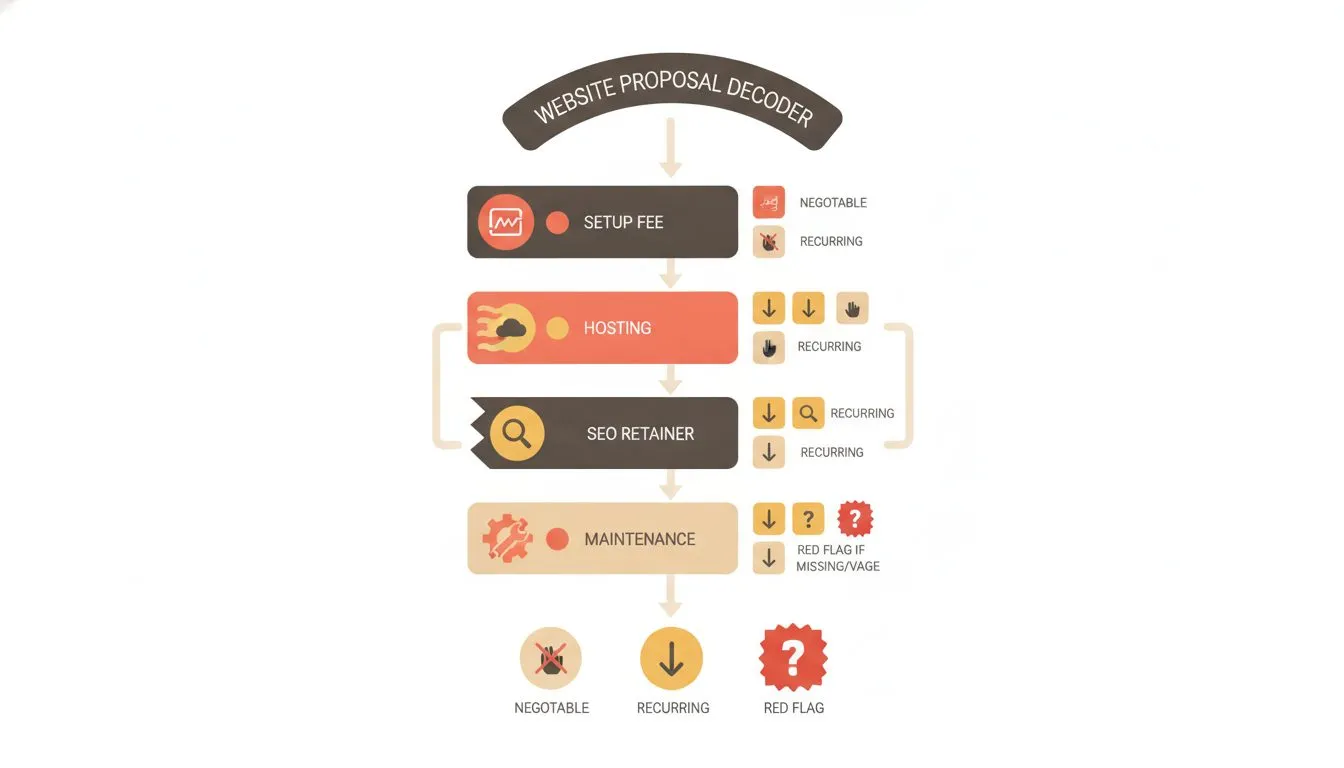
Know what every line of a web quote actually means before you sign anything.
A fair quote is specific. It lists pages, copy, photos, revisions and launch timing. It names every recurring fee, and it says what happens when you cancel.
Compare quotes line by line, not by total. A $2,500 quote that includes copywriting, photos and hosting can beat a $1,800 quote that bills each separately. Two or three comparable quotes show you where the middle sits.
Watch for these warning signs:
- The quote won't say who owns the domain or hosting account.
- Pricing is "custom" with no range, even after you've described your needs.
- A long contract starts before the site is finished.
- Moving the site away later carries a fee, or means losing the site entirely.
Any one of these deserves a direct question. Two or more deserve a different vendor.
Matching your budget to your business
A solo electrician starting out needs a credible presence at a low monthly cost. A builder, WordPress you build yourself, or a site built with your hosting all fit. If you already pay for Jobber, its included website may be enough.
A two- or three-truck plumbing company may want more pages, a booking form and reporting. A freelancer, field service software with online booking, or a hosting plan with room to add pages fits that stage.
A larger contractor chasing commercial work can justify an agency. At that size, an extra booked job a month can cover the retainer. Even then, keep the domain and hosting in your own name.
One rule applies at every stage: never pay for features you can't explain. If a line item isn't tied to calls, quotes or trust, ask what it does.
The bottom line
A plumber or electrician doesn't need a five-figure website to look professional. A fast, clear, mobile-friendly site with your number on top does most of the work. Pay more only when the extra spend is tied to more booked jobs.
If you build it yourself, budget for your time as well as the monthly fee. If you hire, get ownership in writing and compare quotes line by line. If you choose a platform, read what happens to the site when you leave.
Don't have a site yet? We'll build your starter website free with any Flashcloud hosting plan. Tell us about your trade, and a real person sets it up.
Every price in this guide was taken from each company's own website in October 2026.

Neycho Tepavicharov is the co-founder of Flashcloud, with nearly two decades in web hosting behind him and a hosting company he co-founded and sold along the way. He started Flashcloud to make hosting clearer, more generous, and genuinely supportive, and he writes about hosting, performance, how AI is changing the industry, and the occasional strong opinion about where it gets things wrong.
Connect on LinkedIn