How Much Does It Cost To Run A Website Per Year? (2026)

Most small business websites cost roughly $110 to $700 a year to keep running. A self-managed WordPress site on free plugins sits near the low end. Add premium plugins and you climb toward the top. The moment you pay someone else to maintain the site, a retainer of $49 to $250 a month can take your yearly bill into the thousands.
You've built the site. Maybe you did it yourself, maybe someone built it for you, maybe you're about to. Either way, the big question now isn't how to launch. It's what it costs to keep the thing online, year after year. That's what this guide answers: how much does it cost to run a website per year, in plain numbers you can budget against.
This sits under our pillar guide on how to get a website, which covers the routes and the choices. If you haven't built yet and want year-one and build costs, start with how much a small business website costs. This article picks up at year two: what renews, what quietly rises, and what people forget to budget for.
The yearly costs at a glance
Here's the whole picture in one table. Every figure comes from the line-by-line breakdown below it.
Cost | Typical yearly range | Who pays it |
|---|---|---|
Domain renewal | About $12 to $20 for a .com, more after some promotions | Everyone |
Hosting renewal | About $96 to $180 (roughly $8 to $15 a month at renewal) | WordPress and hand-built sites |
Builder subscription | About $144 to $468 | Builder sites (includes hosting) |
Premium plugins | $0 to about $496 | WordPress sites that use them |
Email on your domain | $0 if your host includes it, otherwise per user | Everyone who wants a branded address |
Maintenance retainer | About $588 to $3,000 for most plans ($49 to $250 a month) | Sites someone else looks after |
A site you look after yourself on free plugins sits at the low end. A maintenance retainer is what moves the total into the thousands. Everything in between depends on which extras you actually use.
Every recurring cost, line by line
Domain renewal
A .com renews at roughly $12 to $20 a year across the major registrars. Promotions hide the real number. GoDaddy advertises a .com for $0.01, but that price needs a three-year term where years two and three cost $22.99 each, and it renews at $22.99 after that.
Builders often include the domain free for year one only, on annual billing. Some hosts include it for as long as you stay. The costly mistake is letting a domain lapse, which can be hard to undo. If you want to understand what happens when one expires, read the domain lifecycle.
Domain privacy
Some registrars include WHOIS privacy free. Others charge for it. Verpex adds privacy at $4.95 a year, pre-selected in its cart. Namecheap includes it free. Check your cart before you pay.
Hosting renewal
This is the biggest jump most owners see. Entry shared hosting typically starts around $2 to $5 a month and renews at roughly $8 to $15, every year after the first term. As one example, Flashcloud renews at $9.99 a month on a 12-month term ($8.99 on a 3-year term), with the domain included for as long as you stay.
Builder subscription
Builder plans include hosting and usually continue at the same rate each year, unless your first term was promotional.
- Squarespace: Basic $12/mo billed annually ($144 a year), Core $17 ($204), Advanced $25 ($300).
- Wix: Light $19/mo, Core $29, Business $39, billed yearly. Wix publishes no renewal price.
- WordPress.com Personal: $4/mo for the first 12 months, renewing at $5.
If you're still weighing routes, compare a website builder versus WordPress.
Premium plugins and themes
Free plugins cover most small business sites. If you use premium ones, they renew every year:
- GeneratePress Premium: $59/yr
- WPForms Basic: $39.60 year one, then $99
- Yoast SEO Premium: $118.80/yr
- UpdraftPlus Premium: $70/yr
- Wordfence Premium: $149/yr
That stack costs $436.40 in year one and $495.80 every year after. Most plugin vendors don't publish renewal prices at all, so check before the card is charged.
Email on your domain
Many hosting plans include email accounts on your domain at no extra cost. Zoho Mail's free plan covers one domain and up to five mailboxes of 5 GB each, but works only through Zoho's webmail and apps (no IMAP, POP or ActiveSync). Google Workspace is a paid, per-user, per-month service. Per-user pricing grows with every person you add.
SSL certificate
Most hosts and builders include a free certificate that renews automatically. Some charge. GoDaddy's entry hosting plan renews its SSL certificate at $119.99 a year. If you're unsure why this matters, here's what an SSL certificate is and why your site needs one.
Backups
Some hosts include daily backups. Others sell them as an add-on. MochaHost includes weekly backups and charges $2.95 a month for daily ones. NameHero sells 30-day backup retention for $6.99 a month. Whatever your host provides, keep your own copy too. Here's how to back up a WordPress site.
Maintenance
Published maintenance retainers run from $35 a month to $2,190, with most small business plans between $49 and $250 a month. Of eleven published retainers we checked, five include hosting, one includes it only on the top tier, one excludes it, and four don't say. Ask which before you sign, or you may pay for hosting twice.
Three yearly budgets, worked out
These are year-two-onward numbers, with the arithmetic shown line by line.
Budget 1: WordPress you look after yourself, free plugins
Hosting renewing at $9.99 a month ($119.88) plus a .com renewal of about $14. Total: about $134 a year. If your host includes the domain, about $120. With the premium plugin stack above, add $495.80, for about $630 a year.
Budget 2: Squarespace Core, billed annually
$204 a year, plus the domain renewal at about $12 to $20 once the free first year ends. Total: about $216 to $224.
Budget 3: a site someone else maintains
Hosting and domain at about $134, plus a retainer of $49 to $250 a month ($588 to $3,000). Total: about $722 to $3,134 a year. If the retainer includes hosting, subtract the hosting line.
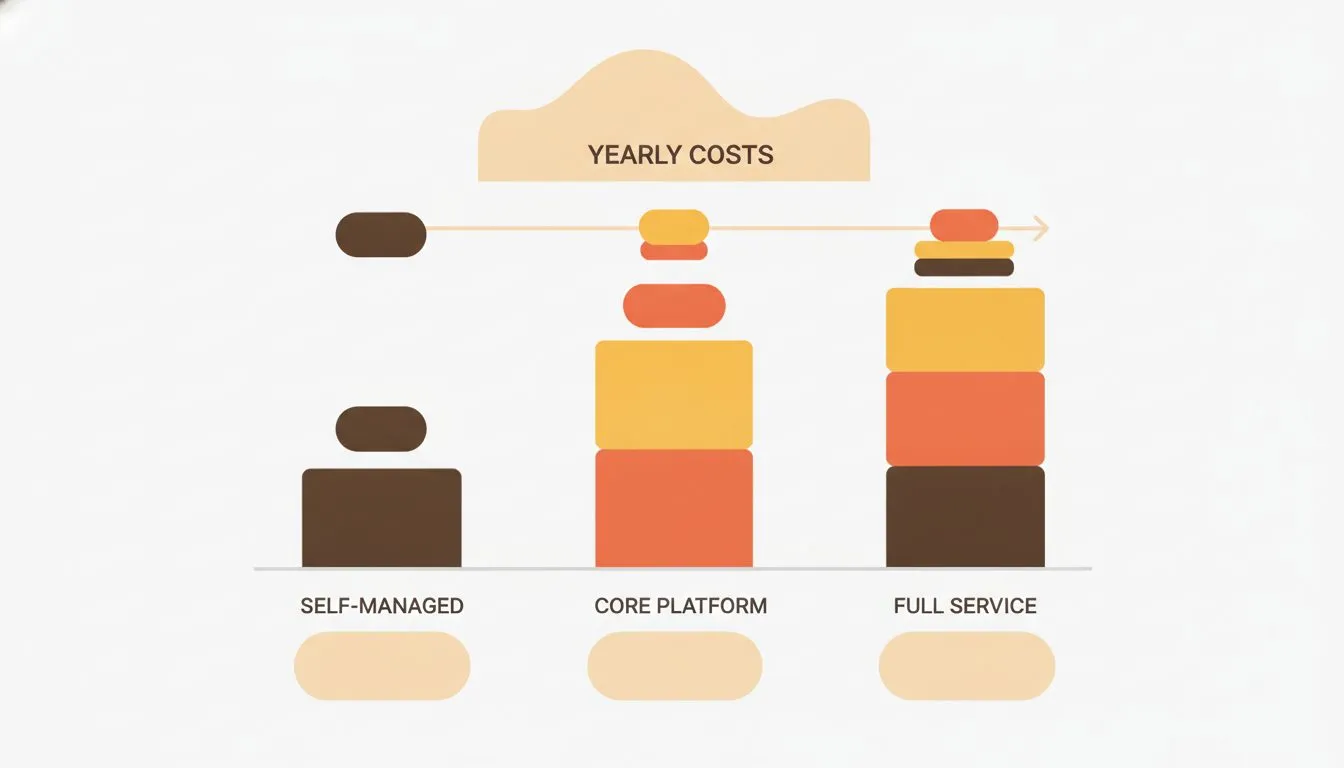
What three common setups cost to keep running each year.
None of these is wrong. The difference is how much of your own time goes into keeping the site updated. A store adds payment processing fees and app or extension costs on top of any of these.
Costs people forget to budget for
These are the lines that don't show up on the first invoice but turn up later.
- Domain privacy, where your registrar doesn't include it.
- Backup add-ons, if daily backups aren't part of your plan.
- Extra email users, charged per user, per month, growing as your team does.
- Premium plugin renewals that auto-charge, often at a higher year-two price.
- A paid SSL certificate on some hosting plans.
- An expired payment card, which can quietly let a domain or hosting lapse.
- Your own time: updates, plugin checks, and testing backups. It's free in cash and expensive in hours. At minimum, test your backups before you need them.
How renewals catch people out
The yearly bill surprises people most often at renewal, not at signup.
- Intro rates end after the first term. The renewal is often three to six times higher. Check the renewal price before you buy, not after.
- Longer terms lock the intro price in for longer, but the full renewal still arrives eventually.
- Prices can change between terms. As one example, Hosting.com's billing policy says prices "may change between Renewal Terms". The new price appears on the renewal invoice, generated 14 days before the renewal date and charged 3 days before it.
Practical tip: open every renewal invoice the moment it arrives and check the price. If the renewal no longer makes sense, moving hosts is usually free. Here's how to switch web hosting.
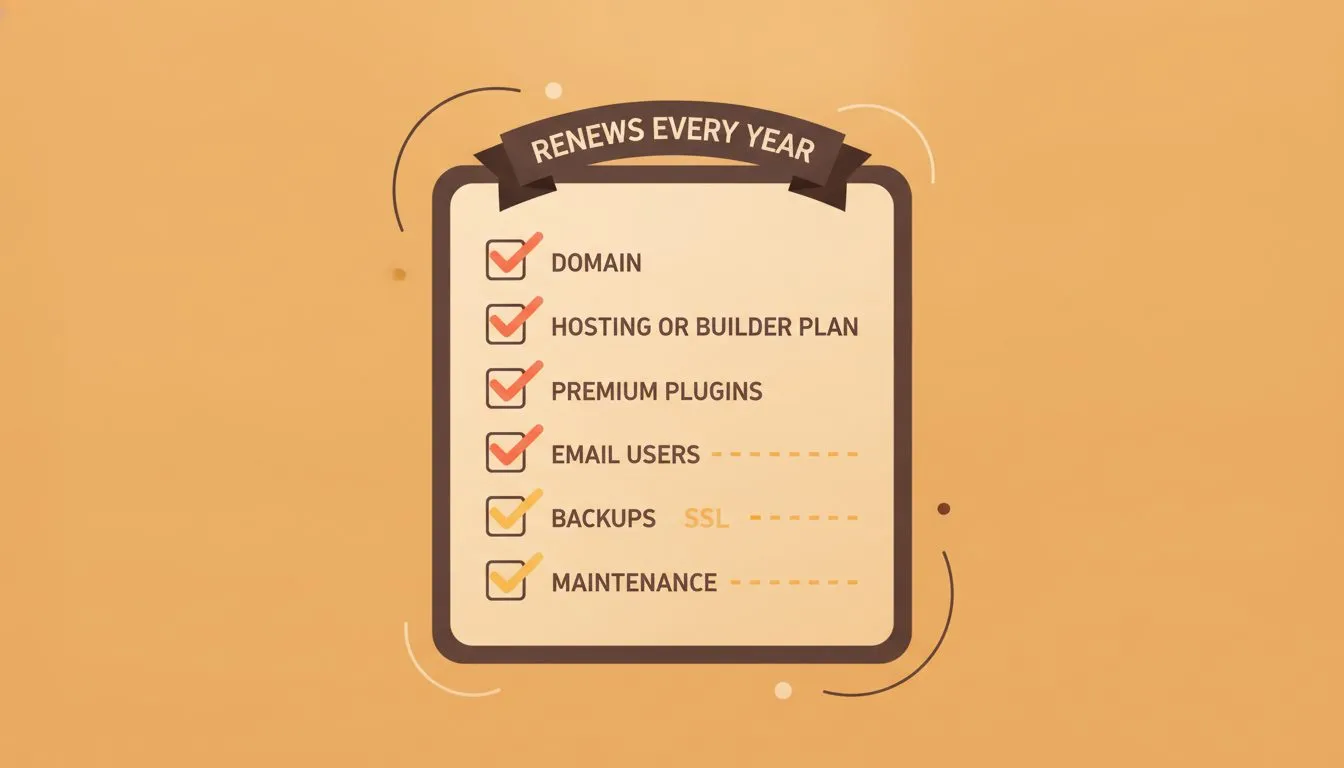
The costs that come back every year.
If you're in a specific industry
Plumbers, electricians and other trades: field service software with a built-in website, such as Jobber at $348 to $588 a year for a solo operator, keeps your site online only while you subscribe. Read more on what a website should cost for a plumber or electrician.
Churches and ministries: the running costs look a little different, and often lean on volunteers and donated time. See how much a church website costs.
How to keep the yearly bill predictable
You can't remove every cost, but you can stop the surprises.
- Put every renewal date in one calendar. Domain, hosting, plugins, email.
- Register the domain in your own name, with auto-renew on. It's your most important asset.
- Compare renewal prices, not intro prices. The intro price is a one-off.
- Use free plugins until you hit a real limit, and cancel plugins you no longer use.
- Look for hosting that includes the domain, email and backups. Bundled essentials keep the bill flat.
- Ask whether a maintenance retainer includes hosting. If it does, don't pay for hosting twice.
- Review the whole bill once a year. One honest hour saves you money.
The bottom line
A website costs less to run than most people fear, as long as you know what renews. The number only runs away from you when a renewal triples quietly, or a retainer doubles as a hosting bill you didn't need. Know your lines, and the yearly cost stays steady.
If predictable renewals matter to you, that's worth checking before you buy. Flashcloud publishes its renewal price up front, includes the domain for as long as you stay, and rises once at renewal, then holds. You can see the numbers on the pricing page.
Every price in this guide was taken from the vendor's own website in October 2026.

Neycho Tepavicharov is the co-founder of Flashcloud, with nearly two decades in web hosting behind him and a hosting company he co-founded and sold along the way. He started Flashcloud to make hosting clearer, more generous, and genuinely supportive, and he writes about hosting, performance, how AI is changing the industry, and the occasional strong opinion about where it gets things wrong.
Connect on LinkedIn