Best Web Hosting for Restaurants in 2026

A hungry diner doesn't browse. She searches your name, taps your link, and wants the menu, the hours and a phone number right now.
Your web host decides whether that page appears in a blink or stalls. The National Restaurant Association projects $1.55 trillion in industry sales for 2026. That's a lot of competition for one diner's attention.
This guide compares seven web hosts that suit restaurants, from bakeries to full-service dining rooms. We also cover the ordering and POS platforms, like Toast and Square, that can run your website for you, and when they're the better call. One host is ours, and we'll flag it when we get there.
Seven restaurant web hosts at a glance
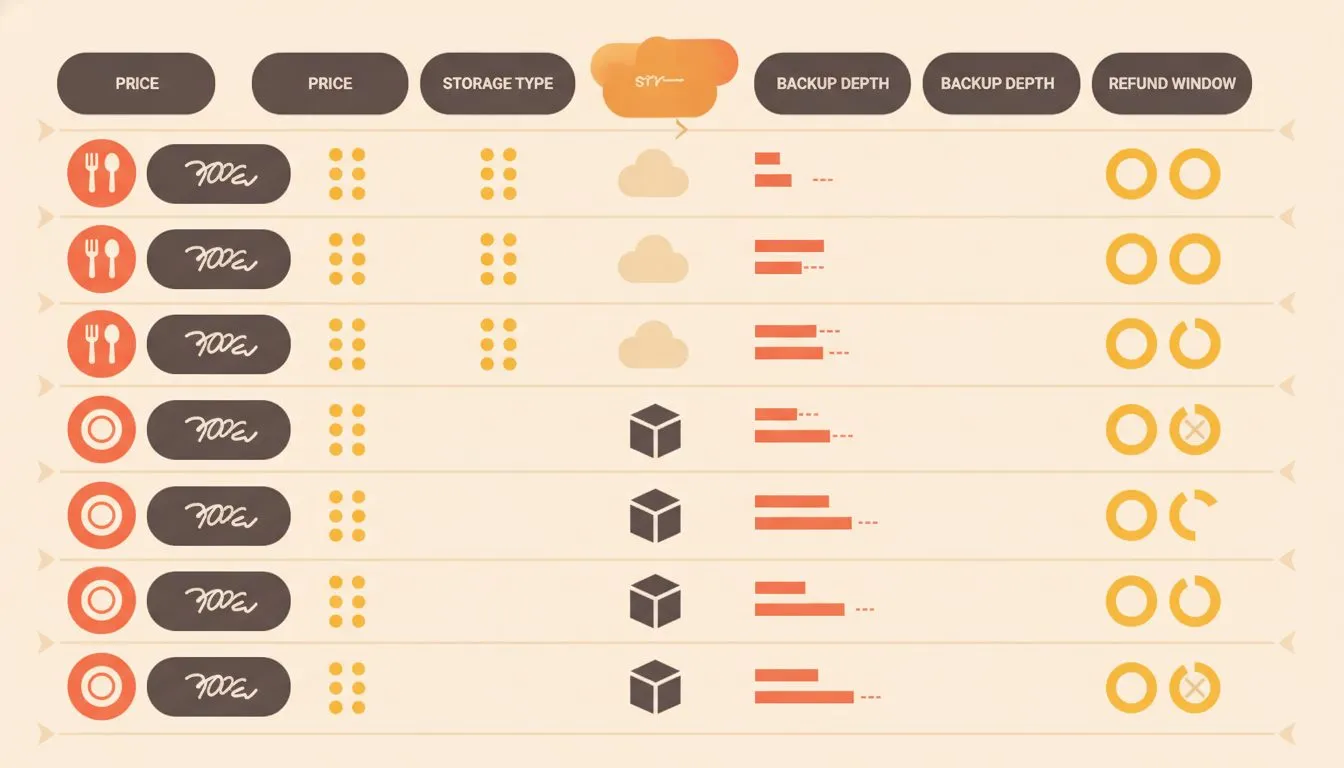
How the seven hosts stack up at a glance
Short version: Flashcloud leads on what's included, with a website built for you and a domain that's free for life. Namecheap and KnownHost keep renewal increases small. AccuWeb is the rare host whose entry plan renews at the price you paid, though with tighter bandwidth and resource limits.
NameHero and ChemiCloud offer low three-year rates with steeper renewals. FastComet has the lowest first-year price. KnownHost suits restaurant groups that want stronger backups on its upper plans.
Host | Starting price | Renews at | Free domain | Backups kept | Money-back |
|---|---|---|---|---|---|
Flashcloud | $2.79/mo (1 year) | $9.99/mo | For life, with privacy | 30 days | Anytime, prorated |
Namecheap | $2.24/mo (1 year) | $4.66/mo | Year one, select extensions | Twice a week, not guaranteed | 30 days |
NameHero | $2.91/mo (3 years) | $11.64/mo | Upper plans only, year one | Pages disagree | 30 days |
ChemiCloud | $1.95/mo (3 years) | $11.95/mo | 3-year plans only, year one | 10 days | 45 days |
FastComet | $1.99/mo (1 year) | $9.95/mo | Not included | 7 days | 30 days |
KnownHost | $3.47/mo (3 years) | $7.16/mo | Not included | 2 daily, 1 weekly | 30 days |
AccuWeb Hosting | $2.79/mo (3 years) | $2.79/mo | Year one | Daily, retention not published | 30 days |
Every row shows each host's entry plan. Starting prices are introductory rates, and renewals are on the same term.
What a restaurant website needs from its host
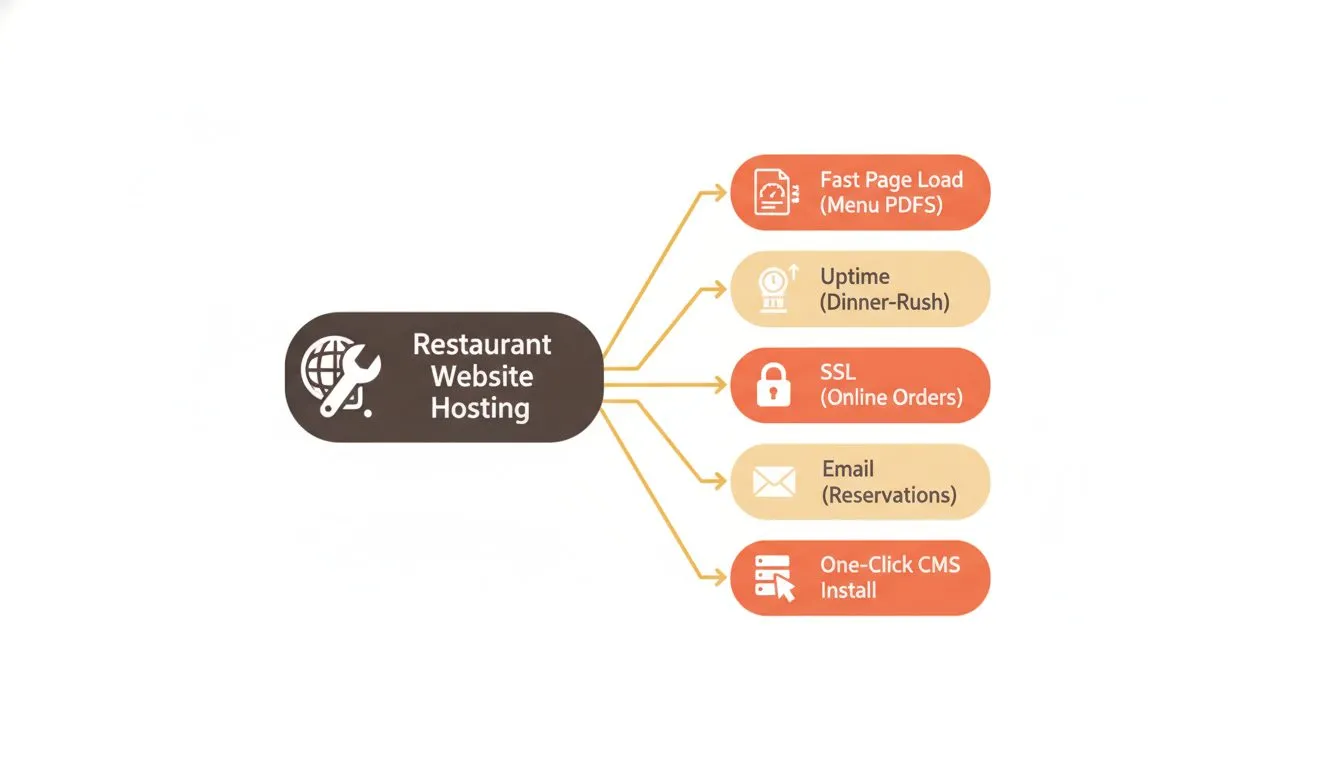
Key hosting features a restaurant website actually needs
A restaurant site isn't a brochure. Diners use it to check hours, read the menu and call. Your host has to keep those pages fast and online, especially on a Friday night.
The National Restaurant Association reports that 7 in 10 restaurants are single-unit operations. Nine in ten have fewer than 50 employees. Few have an IT person, so support that answers fast matters more than a long feature list.
Food photos are heavy files. NVMe storage and built-in caching keep image-rich menus loading quickly on a phone. Ask each host exactly what caching comes with the plan.
Menus deserve special care. Many restaurants post theirs as a scanned PDF, which is really a picture of text. Screen readers can't read it, and phones make it awkward to zoom. The Department of Justice's web accessibility guidance says images need text alternatives and text needs enough color contrast. A plain-text menu on a web page solves both.
Payments add another layer, because online orders make card security matter. The PCI Security Standards Council publishes the data security standard for businesses that handle card payments. Your payment processor will tell you which requirements apply to you.
A common approach sends customers to the processor's hosted checkout. Card numbers then never touch your own server. That keeps your hosting plan simple and your risk smaller.
For ordering on your own site, look at WooCommerce hosting. WooCommerce adds menus, carts and checkout to a WordPress site, with no commission on each order. Confirm your host supports it and offers staging, so you can test menu changes before they go live.
Backups matter more than most owners think. One bad menu update can break a page an hour before service. Look for daily backups you can restore yourself, and check how many days they're kept.
One last step: read the renewal price before you pay. Our guide to choosing web hosting in 2026 explains how to spot hidden limits. Read it before you commit to a three-year term.
1. Flashcloud: a free website, built for you
Heads up: Flashcloud is our product, so we're not neutral here. We've held it to the same checks as every other host on this list.
Flashcloud is built for owners who don't have a website and don't want to build one. You pick a plan. A person on our team builds your starter site, usually within one to two working days.
We launched in early 2026, run by founders with nearly 20 years in hosting. In May 2026, Bitcatcha's speed test scored Flashcloud 5 out of 5, with an A+ speed grade and a 2.4 ms average response time.
Why restaurants pick it
The free starter website is a real, fully editable WordPress site of up to five pages. That covers a home page, menu, hours and location, about, and contact. We build it around your colors, and we make a logo if you need one.
It isn't a drag-and-drop builder, and it isn't an AI generator. One free revision is included, and the site stays fully editable after launch.
The domain is free for as long as you stay, with privacy. SSL, email on your domain and daily backups with 30-day retention come with every plan. Real people answer support, with no chatbot in front of the queue.
Plans and renewal pricing
Start costs $2.79 a month on the 12-month term and renews at $9.99. It includes 25 GB of NVMe storage, 2 CPU cores, 2 GB of RAM and one site. Grow costs $3.79 and renews at $11.99, with 50 GB, 4 cores, 4 GB of RAM and unlimited sites. Scale costs $8.49 and renews at $22.99, with 100 GB, 6 cores and 6 GB of RAM.
The 3-year term works differently. Start costs $2.99 a month and renews at $8.99. The annual term wins year one, while the 3-year term wins on total cost afterward.
There's no inode limit on any plan, so storage is the only limit you'll meet. The price rises once at renewal, then holds. And the renewal rate is published before you pay.
Strengths and trade-offs
The big strength is the bundle. The build, domain, SSL, backups and email all sit inside one price. You make one decision instead of eight.
Switching from another host? Migration is free. If you've prepaid time you won't use at your old host, we add it to your new plan, up to six months. Those are months on your plan, not cash or account credit.
The trade-offs are real. Five pages is a starter site, and an online store or ordering setup isn't part of the free build. Flashcloud is also newer and smaller than the long-established names.
AccuWeb's entry plan beats Flashcloud on renewal price, though with a 750 GB bandwidth cap and half the CPU and RAM. And Namecheap and KnownHost renew at roughly twice their intro price, against more than three times on our annual Start plan. That's worth weighing if the lowest long-term bill matters most to you.
Best suited to
A café, restaurant or food truck with no website. It also fits an owner stuck on a platform they can't leave.
2. Namecheap: low renewals and a simple lineup
Namecheap is a familiar name in domains, and its shared hosting plans are simple to read. For a single-location restaurant, that clarity helps.
Why restaurants pick it
Every shared plan includes free website migration and free domain privacy. A free domain is included for the first year, one per plan. When we checked, .org was free in the cart, but .com and .net cost $5.98.
There's also a 30-day money-back guarantee for first-time shared hosting customers. Watch the plan cards, though. They default to a 30-day free trial, and starting with the trial removes the money-back guarantee.
Stellar Plus and Stellar Business add AutoBackup, with daily, weekly and monthly restore points. You choose a US, UK, EU or Singapore datacenter at the same price.
The plans don't include a built-for-you site, so you or a freelancer builds it. Our comparison of website builders and WordPress helps if you're deciding how.
Plans and renewal pricing
Stellar costs $26.88 for the first year and renews at $55.88 a year. It offers 20 GB of SSD storage and three sites. Stellar Plus costs $34.88 and renews at $85.44 a year, with unmetered SSD storage and unlimited sites.
Stellar Business costs $58.88 and renews at $128.88 a year, with 50 GB and unlimited sites. On Stellar, renewal is roughly twice the first-year price, one of the smallest increases on this list.
Strengths and trade-offs
Low renewals are the headline. Free privacy and free migration add real value on top.
The entry plan runs on SSD rather than NVMe. Its backups are described as "ideally performed twice a week, though not guaranteed", and no retention period is published. Namecheap's own resource guide lists shared plans at 1 to 2 GB of RAM.
Best suited to
A single location with a confident owner or a freelancer handling the site.
3. NameHero: NVMe storage and US datacenters
NameHero is a US-based host that runs every plan on NVMe storage. It publishes CPU, RAM and inode limits for each plan, which not every host does.
Why restaurants pick it
Free migration covers up to 10 cPanel accounts, as long as each full backup is no larger than 1 GB compressed. You can choose a datacenter in Lenexa, Kansas, as well as London or Toronto, at no extra cost. There's a 30-day money-back guarantee, one refund per customer.
Speed matters for image-heavy menus. NVMe storage helps pages with large food photos load without a long pause.
Plans and renewal pricing
Starter costs $2.91 a month on a 3-year term ($104.72) and renews at $418.86 for the next three years. It includes 25 GB of NVMe storage, one site, 1 CPU core and 1 GB of RAM. Plus costs $5.05 a month on the same term and renews at $16.84 a month, with 50 GB and seven sites.
Turbo costs $7.78 and renews at $25.94, with 75 GB and unlimited sites. Business costs $11.68 and renews at $38.94, with 100 GB. Starter and Plus have no monthly option, and monthly Turbo and Business carry an $8.95 setup fee.
Strengths and trade-offs
The specs are clear, and the US datacenter suits American diners.
Starter renews at four times its intro price, whichever term you pick. A free domain comes only with Turbo and Business on a 2- or 3-year term, for the first year, then renews at $20.68. NameHero's own pages also disagree on backups. Its plan page promises daily and weekly backups, while its terms say only one night is kept. It sells 30-day backup retention separately for $6.99 a month.
Best suited to
A single-site restaurant that wants published resources and a US datacenter, and plans its budget around the renewal.
4. ChemiCloud: a long refund window and deep backups on upper plans
ChemiCloud's pitch is a generous money-back guarantee and backups that scale with the plan. Its three-year intro prices are among the lowest here.
Why restaurants pick it
The money-back guarantee runs 45 days for first-time accounts, the longest fixed window on this list. Domain fees, add-ons and paid migrations are excluded. You can pick a US datacenter in Portland or Washington, D.C., or one of seven others, at no extra cost.
Free migration is available for 60 days from sign-up. Backup retention grows with the plan: 10 days on Starter, 20 on Pro and 30 on Turbo.
Plans and renewal pricing
Starter costs $1.95 a month on a 3-year term ($70.20) and renews at $11.95 a month. It includes 20 GB of NVMe storage, one site, 1 CPU core and 2 GB of RAM. Pro costs $2.95 and renews at $17.95, with 35 GB, unlimited sites, 2 cores and 4 GB of RAM.
Turbo costs $3.95 and renews at $21.95, with 50 GB, 3 cores and 6 GB of RAM. On the 12-month term, Starter costs $3.49 a month and renews at $14.95.
Strengths and trade-offs
The 45-day window gives you time to test with real traffic. Backup depth on Turbo is a genuine strength.
The renewal jump is steep, roughly six times the intro rate on Starter. Read the free domain carefully, too. ChemiCloud's plan page says all plans come with a free domain, but its terms limit it to 36-month plans, for the first year only. Each plan also carries an inode limit, from 250,000 on Starter.
Best suited to
An owner who wants a long test period before committing, and who'll budget for the renewal from day one.
5. FastComet: the lowest first-year price
FastComet sells four shared plans, now called Starter, Essential, Plus and Extra. Its first-year price is the lowest on this list, and it shows renewal prices clearly on every plan card.
Why restaurants pick it
Free site transfers come with every plan: one on Starter and Essential, two on Plus and three on Extra. FastComet also advertises compensation for up to six months of unused time at your old host. Every plan uses NVMe storage, and all carry a 30-day money-back guarantee.
A US datacenter in Dallas is offered at checkout, alongside five others.
Plans and renewal pricing
Starter costs $1.99 a month for the first year and renews at $9.95. It includes 10 GB of NVMe storage, one site, 1 CPU core and 1 GB of RAM. Essential costs $2.99 and renews at $12.95, with 20 GB and one site.
Plus costs $3.99 and renews at $17.95, with 30 GB and unlimited sites. Extra costs $5.49 and renews at $24.95, with 40 GB. Backups are kept for 7 days on the first three plans and 30 days on Extra.
Strengths and trade-offs
The first-year bill is small, and the renewal rates aren't hidden.
Starter renews at five times its intro rate. A free domain is no longer included for new customers. FastComet will transfer a domain you already own and renew it free for one year, but a new .com was $23.99 a year in the cart.
The renewal rate isn't fixed either. FastComet's service agreement says it can change fees "at any time without notification", effective from your next renewal.
Best suited to
A one-site restaurant that wants the lowest first-year bill and already owns its domain.
6. KnownHost: stronger backups on its upper plans
KnownHost is an established managed host, founded in 2006. Its entry plan is modest, but its upper plans include backup retention most shared hosts charge extra for.
Why restaurants pick it
Professional and Premium keep 30 daily backups at no extra cost. That suits a restaurant group running several sites, where one bad update can't take everything down. Free migration covers moves between cPanel, DirectAdmin and Plesk.
Support tickets are answered around the clock, and you can choose a datacenter in Atlanta, Seattle or Amsterdam.
Plans and renewal pricing
Basic costs $3.47 a month on a 3-year term ($124.92) and renews at $7.16 a month. It includes 10 GB of NVMe storage, one site, 1 CPU core and 1 GB of RAM. Standard costs $6.48 and renews at $11.01, with 25 GB, five sites, 2 cores and 2 GB of RAM.
Professional costs $9.98 and renews at $16.96, with unlimited sites, 4 cores and 4 GB of RAM. Premium costs $19.98 and renews at $33.96. Monthly billing is available, from $6.71 on Basic.
Strengths and trade-offs
The renewal gap on Basic is small, about double the intro rate. The backups on Professional and Premium are a real strength for groups.
No free domain is included on any plan, and a .com costs $15.50 a year. Basic and Standard keep only two daily backups and one weekly. Merging several sites into one account counts as a paid migration, at $35 an hour.
Best suited to
A multi-concept restaurant group that will pay for Professional or above.
7. AccuWeb Hosting: a flat renewal, with tighter limits
AccuWeb sells both Linux and Windows hosting, and it leans technical. Its standout is rare in this category: entry plans that renew at the price you paid.
Why restaurants pick it
Bootstrap ++ costs $2.79 a month on a 3-year term and renews at $2.79. On the 12-month term, it's $3.79 and renews at $3.79. A restaurant planning its yearly budget can count on that number.
The plan includes 25 GB of SSD storage, up to 100 sites, 750 GB of monthly bandwidth, 1 CPU core and 1 GB of RAM. A free domain is included for the first year on annual terms or longer. Daily backups are included, though retention isn't published. Datacenters include Denver and Dallas, plus six outside the US.
Plans and renewal pricing
Premium ++ costs $3.99 a month on the 3-year term and renews at $9.99, with 75 GB, unlimited sites, 1 TB of monthly bandwidth, 2 CPU cores and 1.5 GB of RAM. Enterprise Pro ++ costs $5.99 and renews at $13.99, with 100 GB, 1.5 TB of bandwidth, 2 cores and 2 GB of RAM.
AccuWeb also sells a Budget plan at $1.99 a month that renews at $1.99. It's a small plan, with one site, 10 GB and US hosting only. It appears only on AccuWeb's pricing page, not on its main Linux hosting page.
Strengths and trade-offs
Fixed pricing on the entry plans is the clear strength. No other entry plan here matches it.
The flat price comes with tighter limits. Bootstrap ++ caps bandwidth at 750 GB a month, where many hosts set no cap. Its 1 CPU core and 1 GB of RAM are half what our Start plan includes, and it doesn't include a CDN. Every plan also carries an inode (file count) limit: 200,000, 250,000 and 300,000 across the three tiers. Backup retention isn't published, and the entry plan runs on SSD rather than NVMe. AccuWeb's terms also say discounts apply only to the first term and add an early termination fee on discounted long terms. Ask how those fit with the flat renewal before you buy. Our guide to testing your backups shows what to check.
Best suited to
An owner who values a fixed bill above everything else, with a small site that stays well inside the limits.
8. Ordering and POS platforms: when your website comes with your till
When your website and your till come from the same provider
Toast, Square, Popmenu, Owner.com and BentoBox take a different approach. Your website comes as part of a restaurant system that also handles ordering, payments or marketing. For some restaurants, that's the right call. Just know what you're signing up for.
What each one offers
Toast sells its website as an add-on, part of its Digital Storefront Pro package. Point of Sale plans start at $69 a month, but the website add-on's price isn't published. Toast promotes commission-free online ordering.
Square includes a website builder on its free restaurant plan, with paid plans at $49 and $149 a month per location. Connecting your own domain needs a paid plan. Online card payments cost 3.3% + 30¢ on the free plan and 2.9% + 30¢ on paid plans.
Popmenu includes a website on every plan, from $159 a month billed annually or $179 monthly. Online orders carry a flat $1.00 fee, which you can pass to the guest or absorb.
Owner.com includes a website, online ordering and a branded app on every plan. It costs $249 a month plus a 5% restaurant fee per order, or $499 a month with no restaurant fee. On both plans, guests pay a 5% order support fee.
BentoBox is now part of Clover and is sold only to Clover POS customers. Its pricing isn't published.
What happens if you leave
This is where platforms differ most from hosting. Popmenu's terms say your site "cannot be migrated to another web hosting service". You must export your own content before your agreement ends, and Popmenu may then delete your account. BentoBox's terms say your access to the website ends when the agreement does.
Toast and Owner.com don't publish what happens to your website or domain if you cancel. Ask before you sign. Our guide to what you own with an AI website builder covers the same questions for website builders.
Domains are the bright spot. BentoBox customers register their own domain, so it stays theirs. Square lets you transfer a Square-registered domain out from your dashboard. Popmenu hands over any domain it bought for you once you've reimbursed the cost.
Best suited to
A restaurant that needs ordering, delivery and payments working on day one, and accepts monthly fees for that. If you already own a domain, keep it registered in your own name, whatever platform you choose. Our guide to choosing a domain name explains how.
What three years really cost
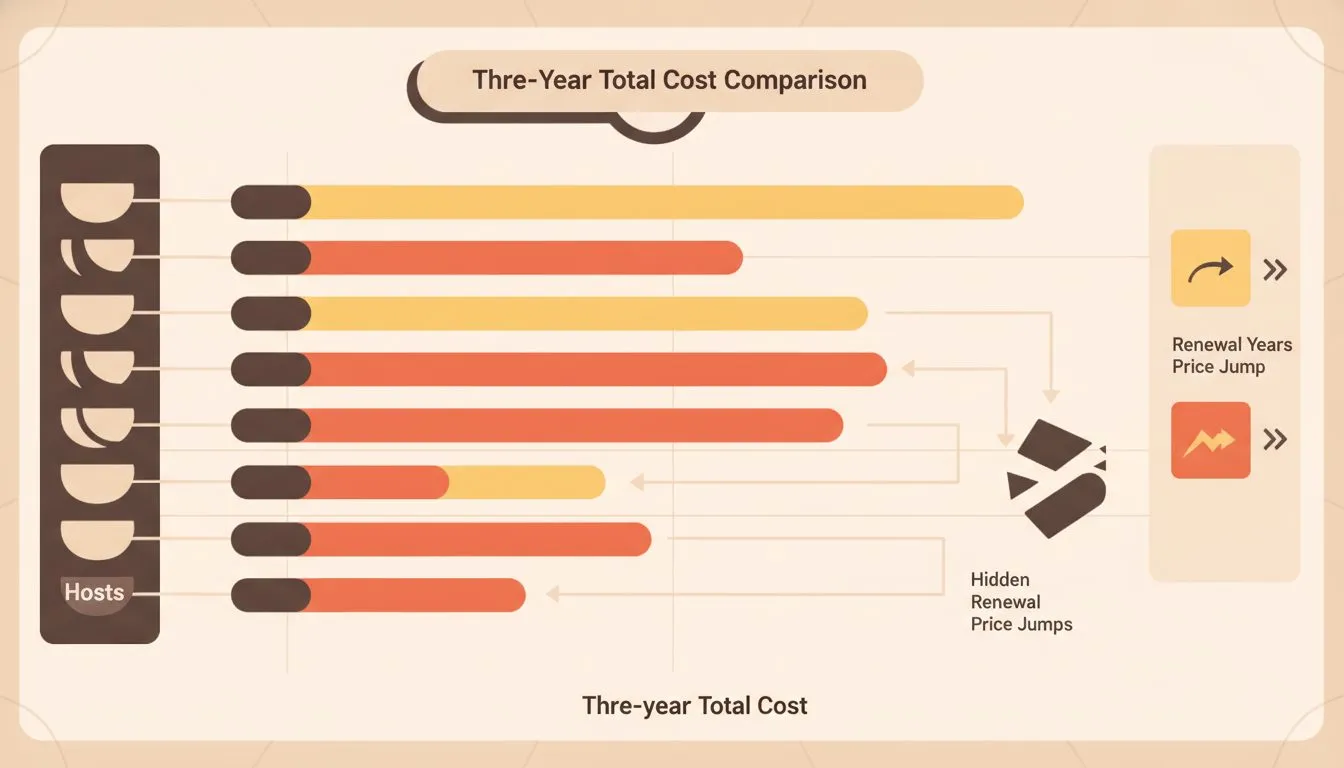
What you'll actually pay over three years - introductory vs. renewal pricing
Intro rates make every host look close. Renewals are where they spread out. Here's what each host's entry plan costs over its first three years, and what the next three years cost at renewal.
Host | First 3 years | Next 3 years | Domain after year one |
|---|---|---|---|
Flashcloud (Start, 3-year) | $107.64 | $323.64 | Free |
Namecheap (Stellar, yearly) | $138.64 | $167.64 | Paid |
NameHero (Starter, 3-year) | $104.72 | $418.86 | Paid |
ChemiCloud (Starter, 3-year) | $70.20 | $430.20 | Paid |
FastComet (Starter, 3-year) | $118.46 | $358.20 | Paid |
KnownHost (Basic, 3-year) | $124.92 | $257.76 | Paid |
AccuWeb (Bootstrap ++, 3-year) | $100.44 | $100.44 | Paid |
AccuWeb is clearly the lowest over six years, though its entry plan caps bandwidth at 750 GB a month and has half our Start plan's CPU and RAM. Namecheap comes second. Flashcloud sits in the middle on price alone. Count a domain renewal of $15 to $24 a year, and a website you'd otherwise pay someone to build, and the picture changes.
Running a salon or barbershop as well? See our guide to the best web hosting for hair salons and barbershops.
Pick the host that fits your kitchen
For a restaurant with no website, Flashcloud removes the build step entirely. For an owner who wants the lowest long-term bill and can handle the site alone, AccuWeb and Namecheap keep renewals low.
NameHero and ChemiCloud suit owners who want a low three-year rate and will budget for the renewal. FastComet fits a one-site restaurant chasing the lowest first-year price. KnownHost fits a multi-concept group ready for its upper plans.
If ordering and payments matter more than owning your site, a platform like Square or Toast may be the faster start. Just ask what happens to your website and domain when you leave.
Whatever you choose, check the renewal price and the backup terms first. They matter more than the intro rate. And if you're stuck with a host you've outgrown, our guide to switching web hosting walks you through the move.
Every price and term in this guide was taken from each company's own website in October 2026.

Neycho Tepavicharov is the co-founder of Flashcloud, with nearly two decades in web hosting behind him and a hosting company he co-founded and sold along the way. He started Flashcloud to make hosting clearer, more generous, and genuinely supportive, and he writes about hosting, performance, how AI is changing the industry, and the occasional strong opinion about where it gets things wrong.
Connect on LinkedIn