Best Website Companies for Plumbers & Electricians in 2026

A burst pipe at midnight doesn't leave time to browse a portfolio. The website work that gets a plumber picked over three competitors usually happens in daylight, long before the emergency call.
Contractors face a strange problem. The trade itself is growing. So is the number of trucks on the road competing for the same jobs.
That's not a guess. Employment of electricians is projected to grow 9% from 2025 to 2035, per the Bureau of Labor Statistics, with around 72,700 openings a year. Plumbers, pipefitters and steamfitters are projected to grow 7% over the same decade, with around 42,000 openings a year. BLS describes both as growing much faster than average.
More competitors chasing the same homeowners raises the stakes. And before most homeowners call, they check. 97% of consumers read reviews for local businesses, per BrightLocal's 2026 Local Consumer Review Survey. The website is where those reviews, your license and your phone number meet.
This list covers eight ways to get a website built. Some are field service platforms that include a site. Some are full marketing agencies. Some are plain hosting.
One is ours, and we'll flag it when we get there.
Every price in this guide was taken from each company's own website on 26 September 2026.
Website companies for plumbers and electricians, compared
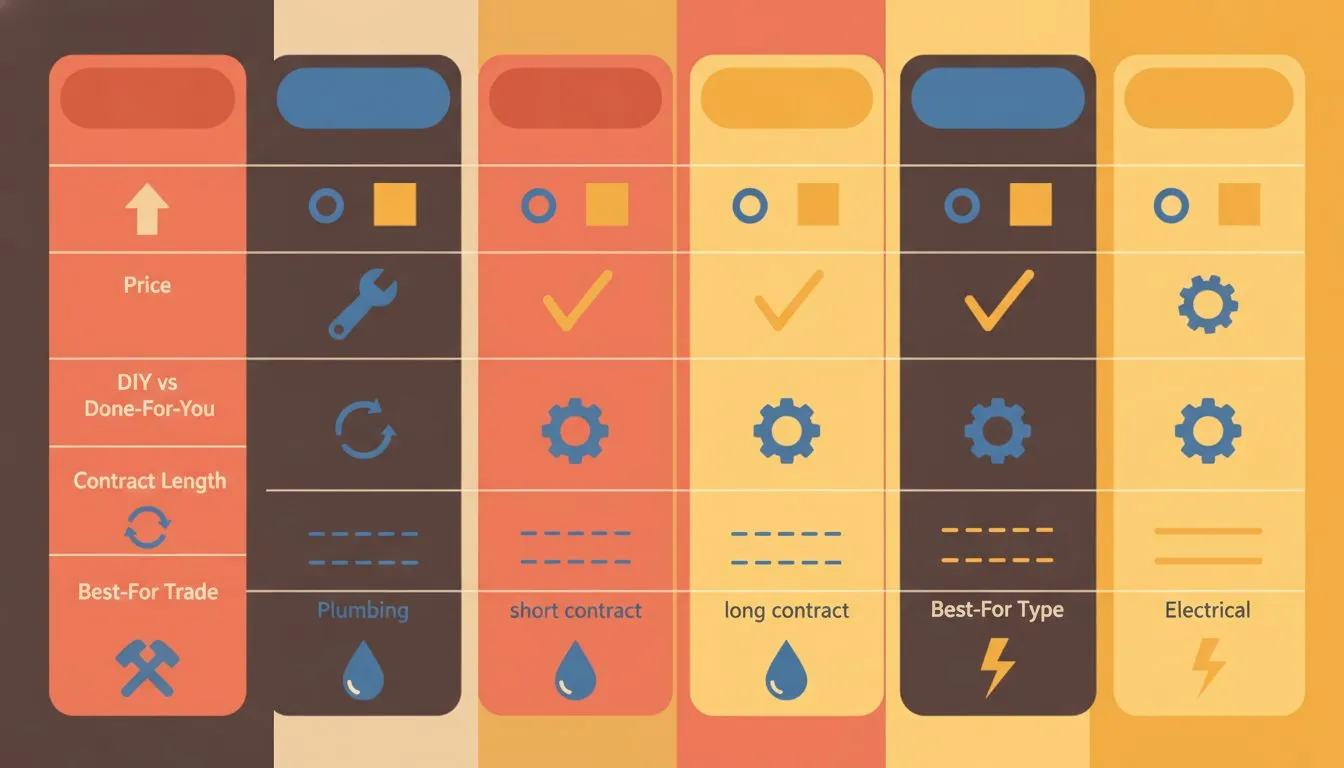
How the top website companies for trades stack up at a glance
Short version: the eight here fall into four groups. Flashcloud and InMotion Hosting are plain hosts. Jobber and Housecall Pro are field service platforms that run your scheduling, quoting and invoicing, with a website attached. NiceJob starts from reviews and sells a website alongside. Hook Agency, Blue Corona and Scorpion are marketing agencies.
A solo electrician building a first site and a multi-truck plumbing company buying an agency retainer need very different things. Knowing which camp you're in narrows this list fast.
Company | What a solo contractor pays with a website | Best for | Key differentiator | Contract |
|---|---|---|---|---|
Flashcloud | $2.79/mo | Contractors with no site yet | A real website, built by a person, free | Anytime money-back guarantee |
Jobber | $49/mo | Solo trades who want one app for everything | Website included on every plan | Monthly, or save with a 1-year term |
Housecall Pro | $79/mo plus a website add-on | Crews already running dispatch and invoicing | Done-for-you website on top of the platform | No long-term contract |
NiceJob | $174/mo plus $199 setup | Contractors whose growth runs on reviews | Reviews and a managed website in one login | Cancel anytime |
InMotion Hosting | $4.79/mo | DIY-minded contractors | A 90-day money-back guarantee | 1 or 3-year terms |
Hook Agency | $1,000/mo for 12 months | Contractors doing $3M to $15M | Published website pricing, rare for an agency | Paid over 12 months |
Blue Corona | Custom quote | Established residential trades businesses | Clear ownership terms, now part of RYNO | Custom |
Scorpion | Custom quote | Growth-focused contractors | Full marketing stack in one vendor | 12 months for website and SEO |
For the platforms, that's the entry plan on monthly billing with a website included. For the hosts, it's the intro rate on each host's standard term. For the agencies, it's the published build price where one exists.
What you keep if you leave
This is the question almost nobody asks before signing, and the answers vary more than the prices do.
Company | What happens to the site when you cancel |
|---|---|
Flashcloud | Your files, database and domain are yours to take anywhere |
Jobber | "Your website will stay online as long as you have an active Jobber subscription." After the term ends, you lose access to account data |
Housecall Pro | Your domain is transferred "at your written request" within 30 days, otherwise not renewed. Site content isn't addressed |
NiceJob | "NiceJob removes all content from the internet upon cancellation." Code export only after the site has been live 36 months |
Hook Agency | "You own your website 100%" |
Blue Corona | "Once it's built, it's 100% yours" |
Scorpion | Domains, content and imagery are yours "after the length of your contract... is complete". The site runs on Scorpion's own CMS, so you get static files and rebuild elsewhere |
The platforms that attach a website to a subscription tend to take the website with them when the subscription ends. The agencies that charge thousands up front tend to hand it over. Neither is wrong, but it is worth knowing which one you're buying. If you're already on one and want to move, our guide to switching web hosting covers the process.
1. Flashcloud: a free website, no retainer required
Bias alert: we built Flashcloud, so we're rooting for it here. We've still tried to give the other seven a fair, accurate hearing.
Most of this list assumes a contractor is ready for a monthly platform or an agency. Flashcloud is built for the ones who just need a site that works.
Inside the offer
If you don't have a website, Flashcloud's team builds one. A real WordPress site, up to five pages, designed around your trade and your service area. We write the copy and source the images if you don't have them.
It's not a drag-and-drop template, and it's not an AI generator. A person builds it, usually within one to two working days.
Every plan includes a domain that's free for as long as you stay, daily backups, and human support around the clock. If you're moving off another host, migration is free, with unused time at your old host credited to the new plan.
What you'll pay
The Start plan runs $2.79/mo on a 12-month term, renewing at $9.99/mo. That covers one site and 25 GB of NVMe storage. Grow and Scale add unlimited sites, which suits a contractor running separate pages for separate service areas.
The free website build is part of the plan, not an add-on.
Where it wins, where it doesn't
It wins on cost, and on removing the "I don't know how to build this" barrier. It doesn't include scheduling, quoting, invoicing or dispatch, the way Jobber and Housecall Pro do, and it doesn't run SEO or ad campaigns, the way the agencies do.
Most contractors pair it with a quote-request form or a booking widget from the tools they already use.
Who it suits
A solo plumber or electrician with no website who wants one built without signing up to a platform or an annual marketing contract first.
2. Jobber: field service software with a website included
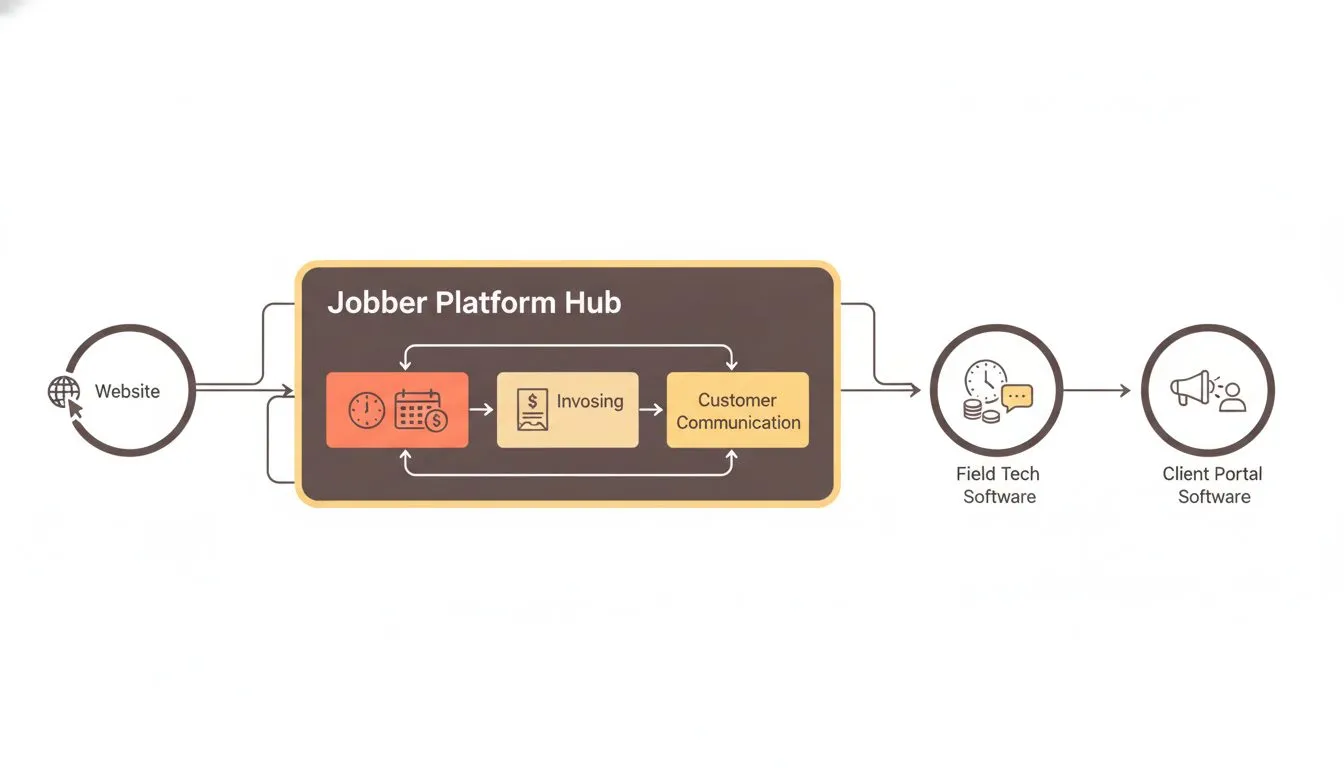
Jobber ties your website directly into your field service workflow
Jobber runs the back office for home service businesses: scheduling, quotes, invoicing, payments and client records. The website is part of that, not a separate product.
Inside the offer
Jobber's own wording: "the website builder is included with every Jobber plan at no additional cost." Quote-request forms and online booking are included on all plans and can be embedded on the site, and Google reviews can be shown on it.
It connects properly to your own domain, through DNS, rather than forwarding. You can connect a domain you already own, or buy one through Jobber's registrar partner. It also connects to your Google Business Profile, adding a Book Online button to your listing, and to Google Local Services Ads so leads land straight in your calendar.
What you'll pay
For a solo operator, Core is $49/mo with no commitment, $39/mo on a 12-month commitment, or $29/mo paid annually. Connect is $139, $119 or $99, and Grow is $199, $169 or $149.
Pricing scales by team size. A crew of two to five on Connect pays $199/mo with no commitment. There's a 14-day trial of the Grow plan with no credit card required.
Card processing is 2.9% plus 30 cents online and 2.7% plus 30 cents for Tap to Pay, with bank payments at 1%.
Where it wins, where it doesn't
It's the only field service platform here that includes the website on every plan, and the domain connects properly. For a contractor who wants one login for everything, that's a strong combination.
The catch is the one in the table above. The site lives only as long as the subscription, and a site can be generated during the trial but not published until you pick a plan. The builder is do-it-yourself rather than done for you. If you're weighing a builder against WordPress generally, we compared them in website builder vs WordPress.
Who it suits
A solo tradesperson or small crew who wants scheduling, quoting, invoicing and a website in one place, and is comfortable building the site themselves.
3. Housecall Pro: a done-for-you website on top of the platform
Housecall Pro covers similar ground to Jobber: scheduling, dispatch, invoicing and payments for home service crews. Its website is built for you rather than by you.
Inside the offer
"Websites by Housecall Pro" is a separate add-on. Their wording: "Get a professional website built and managed by Housecall Pro." It comes in three sizes, one, five or fifteen pages, and you request edits rather than making them yourself. Online booking, a lead form, chat, reviews and a customer portal can all go on the site.
Your domain connects through DNS, or you can transfer it in, or buy one through Housecall Pro. Booking connects to your Google Business Profile through Reserve with Google, and there's a Local Services Ads integration at no extra charge.
What you'll pay
This needs care, because Housecall Pro shows different prices depending on which trade you select in its pricing quiz.
On the general pricing page, Basic is $79/mo for one user, Essentials $189/mo for five, and Max $329/mo for eight, with lower rates on annual billing. Select plumbing and Essentials rises to $299/mo for a team and Max to $649/mo. Check the figure for your own trade.
The website add-on price isn't published on the pricing page, the website page or the help center. You'll need to ask.
Card processing is 2.59% in person, 2.99% when a customer pays an invoice online, and 3.49% for keyed-in cards or American Express. There's a 14-day trial of Max, with no card needed to start.
Where it wins, where it doesn't
The done-for-you website is genuinely useful for a crew with no time to build one, and the Google and Local Services Ads integrations are included.
Two things to know. The website price is unpublished, so you can't compare it until you've spoken to sales. And cancelling can't be completed online: "we cannot fully process your cancellation or pause billing until a team member has spoken with the account owner over the phone."
Their terms also note you "may be required to transfer management of the domain name to Housecall Pro." On cancellation, they'll transfer it back "at your written request," but if no instructions arrive within 30 days, "we will cease to renew your domain name." If you use their website, register your domain yourself. Our guide to what happens when a domain expires explains what that means in practice.
Who it suits
A crew already running dispatch and invoicing that wants a website built and maintained without doing it themselves, and is happy to get a quote for it.
4. NiceJob: reviews first, website second
NiceJob starts with reputation. The core product automates review requests, responses and sharing. The website is an add-on built to show those reviews off.
Inside the offer
Every plan includes a Microsite, which NiceJob describes as "a landing page which allows your customers and leads to view the collection of reviews." That isn't a full website.
The full website is the Sites add-on: "a fully managed, conversion-optimized website," with lead-capture forms, review widgets, call tracking, analytics and SSL. It runs on your own domain, and NiceJob recommends registering the domain yourself.
What you'll pay
Starter is $75/mo and Pro is $125/mo. The Sites add-on is $99/mo plus a $199 setup fee. Extra landing pages are $145 each plus $15/mo, and a blog, services or locations section is $245 setup plus $15/mo.
So a solo contractor with a full NiceJob website pays $174/mo plus $199 to start. There's a 14-day trial and no contract.
Where it wins, where it doesn't
Reviews genuinely move the needle for a trade that competes on trust, and NiceJob is built around getting more of them.
The cancellation terms are the strictest on this list. Their own wording: "NiceJob removes all content from the internet upon cancellation." You keep ownership of the content and images you supplied, but an HTML and CSS export is only offered once the site "has been live with us for 36 months," and stock images "aren't transferable."
Who it suits
A contractor who already gets plenty of work and wants to turn happy customers into more of it, and who plans to stay long enough for the terms not to matter.
5. InMotion Hosting: build it yourself, with a 90-day guarantee

InMotion lets you build at your own pace, backed by a 90-day money-back guarantee
Not every contractor wants a platform or an agency. InMotion Hosting sits at the plain-hosting end of this list, for owners happy to build a simple site or hire someone to.
Inside the offer
Shared hosting with NVMe storage and unmetered bandwidth. The entry Launch plan covers two websites and 100 GB, Power covers 10 sites and 200 GB, and Pro covers 40 sites and 300 GB. A free domain is included for the first year.
There's a detail worth knowing for a trade that runs on phone calls. Launch includes live chat support only. Phone support starts on Power.
What you'll pay
On a 1-year term, Launch is $4.79/mo renewing at $14.99, Power is $5.79/mo renewing at $18.99, and Pro is $10.59/mo renewing at $25.99.
On a 3-year term the intro rate is slightly higher, $4.99, $5.99 and $10.99, but each plan renews a dollar lower. So the longer term trades a higher start for a lower year two.
Where it wins, where it doesn't
A 90-day money-back guarantee is generous for a fixed-day window, and the entry plan's 100 GB of storage is more than most small sites will use.
What you give up is everything a platform or agency would handle. There's no bundled website build, no scheduling and no marketing. The renewal is also roughly three times the intro rate.
Who it suits
A contractor comfortable hiring someone to build the site or doing it themselves, who wants somewhere solid to put it.
6. Hook Agency: a specialist that publishes its prices
Hook Agency works only with home service trades: roofing, HVAC, plumbing, electrical and similar. It's also one of the few agencies in this space that publishes what a website costs.
Inside the offer
A website paired with marketing services: local SEO, Google Ads and Meta ads. Hook describes the Standard website as "a templated, conversion-ready site."
What you'll pay
The Standard website is $1,000/mo, a $12,000 total split across twelve months. The Custom website is $2,000/mo, or $24,000 over twelve months, and Hook says more complex sites can cost up to $50,000.
Marketing services are priced separately. Local SEO starts at $2,800/mo, PPC from $2,000/mo, and Meta ads from $3,000/mo.
Where it wins, where it doesn't
Published pricing is rare in this market and genuinely useful. So is the ownership line in their FAQ: "You own your website 100% (many companies don't operate that way surprisingly.)" For ads, "you own your account, and your credit card is connected to the spend."
Hook is also clear about who it's for. Its homepage says its services "are tailored to meet the needs of businesses generating $3M to $15M in revenue." A solo contractor isn't the intended client.
Who it suits
An established contractor in that revenue band who wants a trade specialist handling the website and marketing together.
7. Blue Corona: a trades marketing agency, now part of RYNO
Blue Corona focuses on residential trades: HVAC, plumbing, electrical, roofing and related work. In October 2024 it merged with RYNO Strategic Solutions, "unifying under the RYNO Strategic Solutions brand," though its own site still trades as Blue Corona.
Inside the offer
Website design for trades businesses, with dedicated pages for plumbers and electricians, alongside digital marketing services. It doesn't publish an itemised package, so ask what the website build includes and what's charged separately.
What you'll pay
No fee, range or minimum is published on the site. The only figure it offers is a comparison: it puts the cost of an in-house marketer at a minimum of $8,000 to $10,000 a month, and says Blue Corona costs "less than the cost of a single entry level employee." Expect a consultation and a custom quote.
Where it wins, where it doesn't
The ownership statement on its plumbing and electrical pages is clear: "Some plumber web design agencies have contract clauses that say if you leave, you have to pay a large fee, or you don't own your website. That's not the case with Blue Corona. Once it's built, it's 100% yours."
The trade-off is no published pricing, so you can't compare it before a sales call.
Who it suits
An established residential trades business that wants a marketing partner and values a plain statement that the website is theirs.
8. Scorpion: a full marketing stack in one vendor
Scorpion serves home service contractors alongside other industries, including legal, and its homepage says it has helped over 20,000 businesses. Its pitch is a complete growth package rather than a website on its own.
Inside the offer
For trades, Scorpion sells a bundle it calls RevenueMAX, described as "the digital marketing and technology solution that drives calls, jobs, and revenue for your electrical business." It covers website design, SEO, paid advertising, Local Services Ads management, reviews, and an AI assistant called Scorpion Connect that can "answer questions, book appointments, accept payments, and educate customers" around the clock. Lead scoring is built into the website.
Scorpion says launch typically takes "four to 10 weeks, depending on the specifics of your contract."
What you'll pay
Nothing is published. Its FAQ answers the cost question with: "The investment you decide to make with Scorpion depends on your business goals." Expect a consultation and a quote.
The contract term is published: "Scorpion typically requires a 12-month contract for our marketing technology and certain marketing services like search engine optimization (SEO)." Advertising services such as Google Ads and Local Services Ads are "typically month-to-month."
Where it wins, where it doesn't
One vendor for website, SEO, ads and lead handling is a real convenience for a contractor who'd rather not manage three.
The ownership terms need reading closely. Scorpion's FAQ says "you own your website after the length of your contract with Scorpion is complete," and that the domains, content and imagery are yours. But the site runs on Scorpion's own content management system, which you never own. If you leave, you receive "your website's static files, design assets, and content," and, in their words, "you'll need to work with another vendor to rebuild your website."
Every ownership statement is tied to completing the contract. Nothing published covers leaving early, and Scorpion links no terms of service from its site, so ask for the contract terms in writing before you sign.
Who it suits
A contractor with real marketing budget who wants everything handled by one team, is comfortable with a 12-month commitment, and plans to stay.
A word on Google Local Services Ads
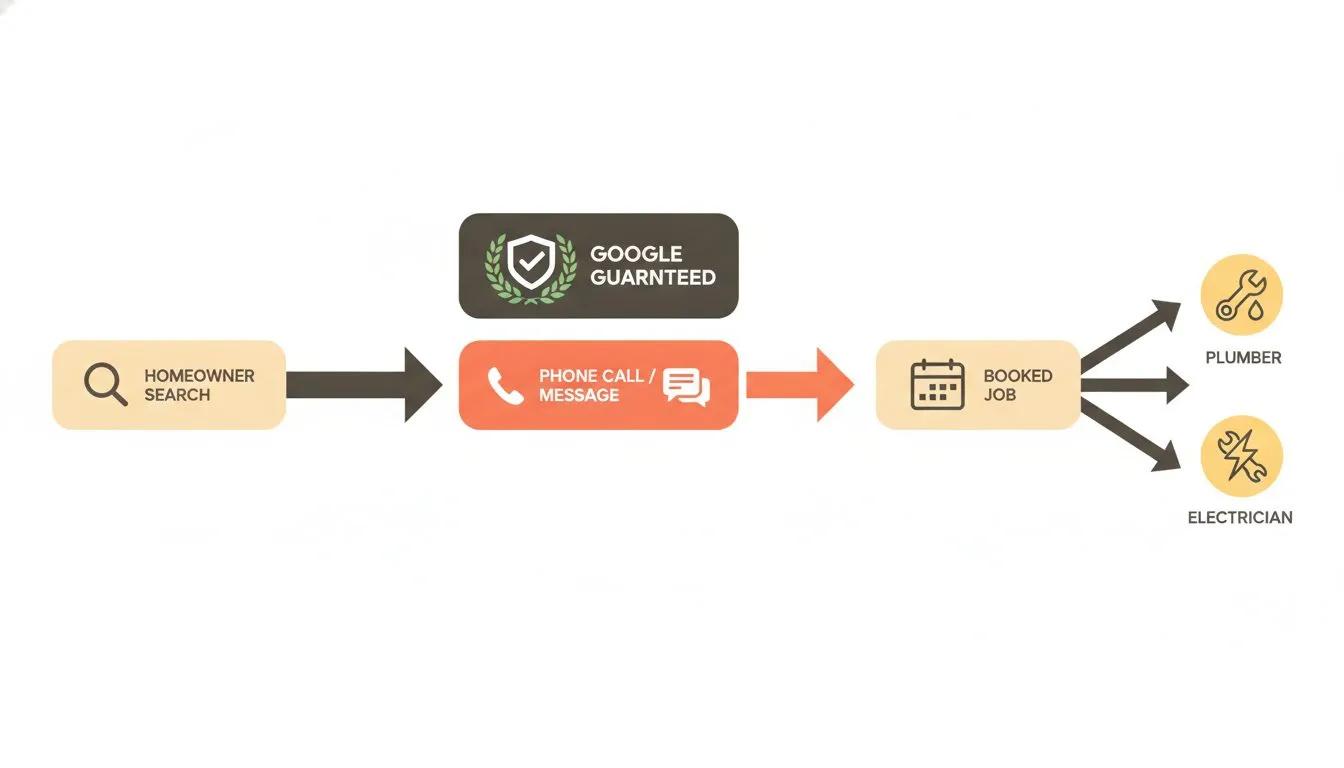
How Google Local Services Ads send verified leads straight to your phone
For most plumbers and electricians, Local Services Ads are the lead source that sits alongside the website, so it's worth knowing how they work now.
You pay per lead rather than per click. Google says you pay for customers rather than clicks, and leads it judges invalid or low quality aren't charged. Both "Electrician" and "Plumber" are eligible categories in the US.
One recent change catches people out. Google has replaced the separate Google Guaranteed and Google Screened badges with a single "Google Verified" badge, and has discontinued its Money Back Guarantee. Any guide still describing the old badges is out of date.
Jobber and Housecall Pro both connect to Local Services Ads, so leads flow straight into the software you already use.
What to ask before you sign with anyone
A few questions, asked before you commit, close most of the gaps in this list.
What happens to the website if I cancel? The answers above range from "it's 100% yours" to "removes all content from the internet." Get it in writing. We cover the full list of terms to settle in how to hire someone to build your website.
Who registers the domain? Register it yourself, in your own name, wherever you can. It's the one thing that lets you move without starting over. If you haven't picked one yet, see how to choose a domain name.
What's the contract term? Monthly, 12-month commitment, or prepaid annual are very different decisions, and some platforms require a phone call to cancel.
What does the website add-on actually cost? Two of the platforms here sell the website separately, and one doesn't publish the price.
Who writes the content? Some build and write it for you, some give you a builder, and some expect you to supply everything.
The bottom line
Start with what you actually need.
If you just need a website, Flashcloud builds one for you, free, and you add quote forms or booking from tools you already use. It's the lowest cost here, and the site stays yours.
If you want one app for the whole business, Jobber is the one to look at first, because the website is included on every plan and connects to your own domain properly. Just know the site lives only as long as the subscription.
If you'd rather someone else build and maintain the site on your platform, Housecall Pro does that, once you've got a quote for the add-on.
If reviews are your biggest lever, NiceJob is built around them. Read the cancellation terms before you commit.
If you've got real marketing budget, Hook Agency publishes its prices and targets $3M to $15M contractors. Blue Corona and Scorpion quote custom, and Scorpion asks for a 12-month commitment on the website and SEO.
If you'd rather build it yourself on plain hosting, InMotion Hosting offers generous storage and a 90-day money-back guarantee.
Whichever way you go, register your own domain and find out what happens to the site if you leave. Those two answers matter more than the monthly price. For the wider picture of every route to a website, see our guide to how to get a website.

Neycho Tepavicharov is the co-founder of Flashcloud, with nearly two decades in web hosting behind him and a hosting company he co-founded and sold along the way. He started Flashcloud to make hosting clearer, more generous, and genuinely supportive, and he writes about hosting, performance, how AI is changing the industry, and the occasional strong opinion about where it gets things wrong.
Connect on LinkedIn